Your own connections or placement help: a fair comparison for Samford NP students
Both routes lead to the same place: a preceptor near home who fits the course, a rotation request that Samford reviews, and a site that Samford approves. What changes is where the connection comes from and who does the searching. Some Samford students place themselves through colleagues and former employers; others bring us in for the course their network cannot cover. Here is how the two compare.
Tell us which courses need a preceptor
List the Samford clinical courses your own network already covers and the ones it does not. Your placement advisor plans the rest around your terms and your ZIP code.
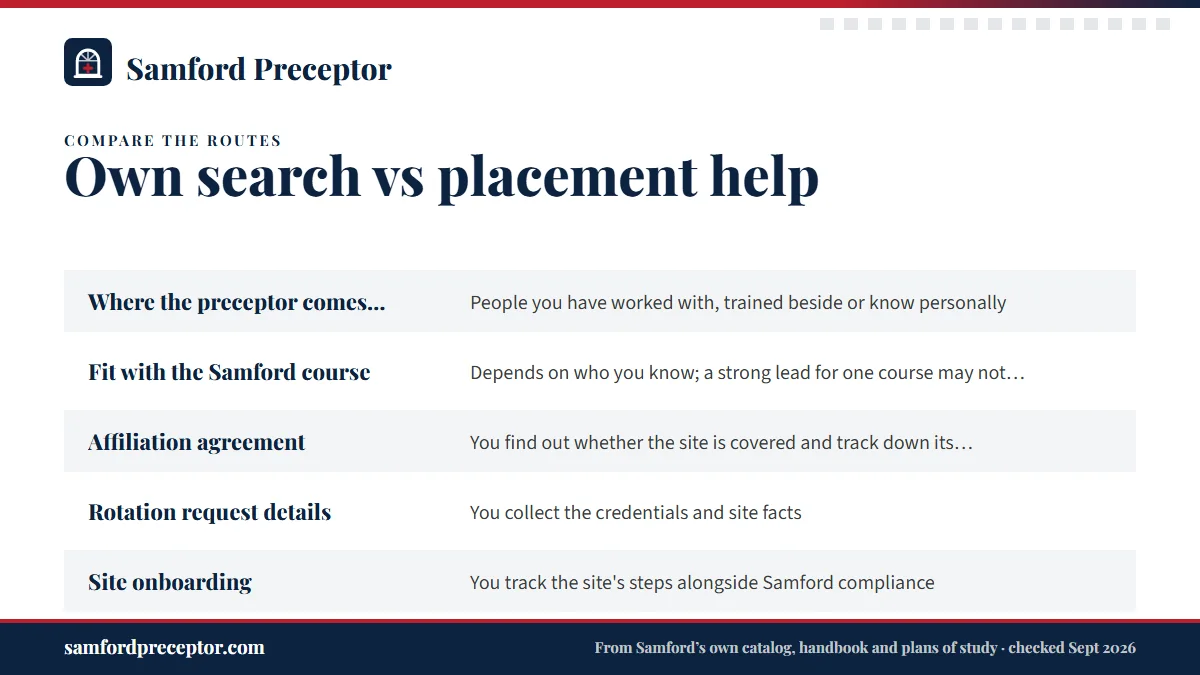
Same destination, two ways to reach it
Samford's NP program pages present connections as the way students secure placements close to home, supported by the school's agreements with hundreds of clinical agencies and its readiness to add more. Nothing in Samford's public documents ranks one source of connection above another, and no Samford page, current or archived, discusses placement companies. Every preceptor, however you met them, passes through the same clinical rotation request and the same approval.
That makes the choice practical rather than a matter of principle. For this course, in this term, where you live, which route produces a preceptor who fits, early enough for the paperwork to finish? The answer can differ from one course to the next.
The two routes side by side
| Question | Your own connections | Placement help |
|---|---|---|
| Where the preceptor comes from | People you have worked with, trained beside or know personally | A search run for you across practices in your community |
| Fit with the Samford course | Depends on who you know; a strong lead for one course may not suit the next | Matched to the course's population and hours before you are introduced |
| Affiliation agreement | You find out whether the site is covered and track down its contract signer | Flagged early, with the site's contract signer identified for Samford |
| Rotation request details | You collect the credentials and site facts | Organized for you to submit |
| Site onboarding | You track the site's steps alongside Samford compliance | Tracked on one timeline with your term |
| If the preceptor withdraws | You restart the search, often mid-term | A replacement search picks up from an existing plan |
| What it costs | Your time, calls and any travel | A fee quoted for your program, course, location and timing |
| Who chooses the preceptor | You | You, from options that fit |
Samford's own costs sit outside both columns: tuition, fees and compliance items such as background checks, plus any added screening a site asks for, which the handbook places at the student's expense.
When your own network is the stronger route
If you already know a family NP, a primary care physician or a psychiatric clinician who is willing to teach, start there. A clinician who has seen your work is often the easiest yes, and a practice that has hosted Samford students before may already sit under a Samford agreement. Your own route tends to work best when these hold:
- A clinician you trust has offered, in writing, to take you for the whole term.
- The practice sees the population the course calls for, such as adults for
NURG 723or all ages forNURG 724. - The site is close enough for 10 to 20 hours a week on top of your job.
- There is still time for Samford to add an agreement if the site needs one.
Clinicals at your own employer raise questions of their own; clinicals where you work lists what to settle first.
When placement help earns its place
Help pays off when your network runs thin for a particular course. Common Samford situations where outside help fits:
- You work inpatient and know no one in outpatient primary care, the setting most FNP courses need.
- You are a PMHNP student looking for someone who can supervise the psychotherapy hours in
NURG 767, or an outpatient psychiatric practice forNURG 788throughNURG 790. - You live well outside the Southeast, where Samford holds fewer agreements and a new one is more likely.
- A 300-hour course such as
NURG 730orNURG 790is ahead, and your usual contacts cannot commit to about 20 hours a week. - A preceptor withdrew after the term started.
- The course opens within weeks and cold calls have gone unanswered.
Samford's line about connections was written with gaps like these in view; the connections guide reads it closely.
Using both across your program
The decision is per course, not per program. An FNP student might place NURG 723 with a physician from their own hospital, then need help with the pediatric side of NURG 724 and with the NURG 730 practicum. A PMHNP student might know a psychiatrist who can take NURG 789 but no one who can supervise therapy for NURG 767.
We work the same way. Tell us which courses your network already covers, and we plan the others, keeping the terms, the on-campus intensives and each site's onboarding on one calendar. If a lead of yours falls through later, the plan already has a place for a replacement. The placement request form takes a note of the courses you have covered.
Five questions to answer before you decide
- How many clinical courses remain, and how many hours does each carry in your plan of study?
- For each course, can you name a willing clinician whose practice fits the population it covers?
- Is that clinician's site likely to need a new Samford affiliation agreement, and is a full term left for it?
- How many hours a week can you give to calling offices, sending resumes and following up?
- If the preceptor withdraws in week six, what is your plan?
If you can answer the first two with names and the last three with ease, your own network may be all you need. If not, how it works shows what we take on, and choosing a placement service lists what any service should do for a Samford student.
Whichever route you take, a verbal yes is not yet a placement. It becomes one when the site is covered by an agreement, Samford approves your rotation request, and both your compliance file and the site's onboarding are complete.
Questions Samford students ask
Will Samford treat a preceptor I found through a service differently?
Samford's public documents make no distinction based on how a preceptor was found. Samford reviews the preceptor and the site, and it can deny a request on state rules, whatever the route. What helps any request is a close fit with the course and complete details, which is what we prepare. Your program coordinator can confirm how your track handles it.
Is cold-calling clinics a good way to find a Samford preceptor?
It can work, but it is slow. Front desks field many student requests, some practices take students only from schools they already know, and messages often never reach the clinician. An archived Samford PMHNP page likened placement to a job hunt, with applications and interviews. Warm introductions through people who know your work usually move faster.
Can I switch to placement help partway through my program?
Yes. You can start with your own contacts and bring us in later, for example for a 300-hour practicum or after a preceptor withdraws. Send the course, the term and the practices you have already approached, so the search starts fresh ground instead of repeating calls you have made.
Does a placement service cost more than finding a preceptor myself?
A service charges a fee, quoted for your program, course, location and timing. Your own search is paid for in time instead: calls, follow-ups and sometimes lost weeks when a lead falls through. Samford's tuition, fees and compliance costs are the same either way. The cost page explains how our quotes are built.
Can a classmate's former preceptor take me?
That is often one of the strongest leads, because the clinician already knows how Samford students train. Ask your classmate for an introduction, confirm the practice suits your course, and check with Samford that the site's agreement is still in place. The request is reviewed like any other.
Related pages
Last checked 2026-09-25
We check these pages against Samford's own program pages, plans of study, the 2026-27 Graduate Nursing Student Handbook and Alabama rules. Your course, your program coordinator and Graduate Student Services have the final word.
Samford says connections are essential. We are the connection.
Tell us your Samford track, where you live and when your next clinical course starts. We find preceptors near you who fit the course and prepare the details Samford needs to approve the rotation, including a new affiliation agreement where one is needed.
- Preceptors matched to the course: adult primary care for
NURG 723, family practice across the lifespan forNURG 724, psychiatric care forNURG 788 - Preceptor, license and site details ready for your clinical rotation request
- In your own community, anywhere Samford accepts you and your RN license is valid
Start your placement plan
Program, city and start date is all we need to begin.