Samford FNP BSN to DNP: four clinical semesters, 1,050 hours and the DNP project
Samford's Family Nurse Practitioner BSN to DNP is a three-year online program that starts in May. Its plan of study lists 1,050 clinical hours across four clinical courses in four straight semesters, NURG 716, NURG 717, NURG 718 and NURG 730, from the spring of Year 2 to the spring of Year 3. The DNP Project runs through NURG 760 and NURG 761 in that same final year.
Plan your BSN to DNP preceptors
Tell us your cohort year and where you live, and we plan a preceptor for each of the four clinical courses.
The program at a glance
The BSN to DNP takes a nurse with a bachelor's degree to a Doctor of Nursing Practice as a family nurse practitioner in one continuous plan. Compared with Samford's FNP MSN, it adds a year, a set of doctoral leadership and population health courses, a different run of clinical courses and the DNP Project.
- Length: a “3-Year Program” on Samford's page; the plan of study dated 12.5.25 totals 74 credits, while the 2025-26 catalog says 76
- Start: May; applications open on September 1 and close March 1, though an older Samford page for this track, still online, shows April 15
- Admission: an unencumbered RN license, a bachelor's degree from a CCNE, CNEA or ACEN accredited school and a 3.0 GPA in nursing courses; no minimum RN experience is stated, and the older page adds a research course (C or better) and health assessment (B or better)
- Campus time: the current page lists two to three required on-campus intensives, the older page three sessions of two to four days, and the plan marks visits in Year 1 fall, Year 2 fall and Year 3 spring
- Clinical load: 1,050 hours in the plan, with Samford's page setting weekly clinical time at 10 to 20 hours, varying by rotation
- Eligibility by state: 16 states are closed to Samford NP applicants; see state authorization
Every course in the plan of study
Year 1 and the first half of Year 2 are coursework: sciences, family primary care and the first doctoral courses. Clinical work begins in the spring of Year 2 and then continues every term to graduation.
| Term | Course | Title | Credits | Clinical hours |
|---|---|---|---|---|
| Year 1 summer | NURG 533 | Advanced Physiology and Pathophysiology | 3 | None |
| Year 1 summer | NURG 731 | Concepts of Advanced Practice Nursing | 4 | None |
| Year 1 fall | NURG 610 | Advanced Health Assessment (campus visit) | 4 | None |
| Year 1 fall | NURG 633 | Pharmacotherapeutics for the APRN | 3 | None |
| Year 1 fall | COHS 500 | Introduction to Interprofessional Practice | 1 | None |
| Year 1 spring | NURG 706 | Family Primary Care I | 4 | None |
| Year 1 spring | NURG 732 | Theoretical Principles of Evidence-Based Practice | 4 | None |
| Year 2 summer | NURG 707 | Family Primary Care II | 4 | None |
| Year 2 summer | NURG 733 | Systems-Based Practice | 4 | None |
| Year 2 fall | NURG 600 | Common Diagnostics and Procedures (campus visit) | 3 | None |
| Year 2 fall | NURG 708 | Family Primary Care III | 4 | None |
| Year 2 fall | NURG 709 | Advanced Clinical Reasoning (simulated) | 3 | None |
| Year 2 spring | NURG 714 | Care in the Community | 3 | None |
| Year 2 spring | NURG 716 | FNP Clinical I | 3 (4) | 225 |
| Year 2 spring | NURG 734 | Essentials of Population Health | 4 | None |
| Year 3 summer | NURG 717 | FNP Clinical II | 3 (4) | 225 |
| Year 3 summer | NURG 781 | Leadership, Organizational and Strategic Management Theory | 3 | None |
| Year 3 fall | NURG 718 | FNP Clinical III | 4 | 300 |
| Year 3 fall | NURG 760 | DNP Project I | 2 | None |
| Year 3 fall | NURG 783 | Business Skills and Principles for the APN | 3 | None |
| Year 3 spring | NURG 730 | NP Practicum (campus visit) | 6 | 300 |
| Year 3 spring | NURG 761 | DNP Project II | 2 | None |
The two-credit gap between plan and catalog comes from NURG 716 and NURG 717, which the plan lists at 3 credits each and the catalog at 4. Your plan of study and Degree Works audit are the records to check against.
Four clinical semesters without a break
The BSN to DNP does not use the MSN's NURG 723 and NURG 724. It has its own three FNP clinical courses and then joins the other FNP tracks for the final practicum.
| Course | Term | Credits (plan / catalog) | Clinical hours |
|---|---|---|---|
NURG 716 FNP Clinical I | Year 2 spring | 3 / 4 | 225 |
NURG 717 FNP Clinical II | Year 3 summer | 3 / 4 | 225 |
NURG 718 FNP Clinical III | Year 3 fall | 4 / 4 | 300 |
NURG 730 NP Practicum | Year 3 spring | 6 / 6 | 300 |
Two features set this sequence apart. The first clinical course is 225 hours rather than the MSN's 150, so the opening preceptor carries more time from the start. And the four courses run back to back, so each next preceptor has to be settled while you are still in the current rotation. What each course asks of a preceptor is laid out on the BSN to DNP clinicals page, and the final semester on the NURG 730 practicum page.
750 or 1,050: the hour conflict
Samford's FNP DNP page repeats the text block used on every NP page: “This pathway requires a minimum of 750 clinical hours”. The BSN to DNP plan of study, dated December 2025, totals “Clinical hours – 1050”. The two figures come from Samford's own documents and do not match.
The graduate handbook explains why the plan runs higher. In its words, CCNE sets a floor of 1,000 post-baccalaureate hours of supervised practice for the doctorate, and nurses who enter without earlier APRN preparation may need added courses or independent study to reach 1,000 clinical hours after the BSN. A BSN-entry student has no MSN hours to carry in, so the plan builds them in.
Plan your preceptors against 1,050 and confirm the figure with your program coordinator. The 750 clinical hours page explains the shared wording, and the DNP's 1,000 hours covers how the doctoral count works.
A preceptor who agrees to “the Samford minimum of 750” has agreed to the wrong number for this track. Share the course-by-course hours from the plan: 225, 225, 300 and 300.
The DNP Project in the final year
Beyond the clinical courses, the doctoral layer adds Systems-Based Practice, Essentials of Population Health, Care in the Community, leadership theory and business skills, then the DNP Project in two parts.
Samford's handbook says the project proposal is written in NURG 760 DNP Project I and completed in NURG 761 DNP Project II. The catalog grades both pass/fail and allows repeats up to 8 credits. In the plan, NURG 760 sits beside the 300-hour NURG 718 in Year 3 fall, and NURG 761 beside the 300-hour NURG 730 in Year 3 spring, which makes the last two semesters the busiest of the program.
That overlap is one more reason to confirm both final preceptors early, so a late search never competes with the proposal.
When to line up each preceptor
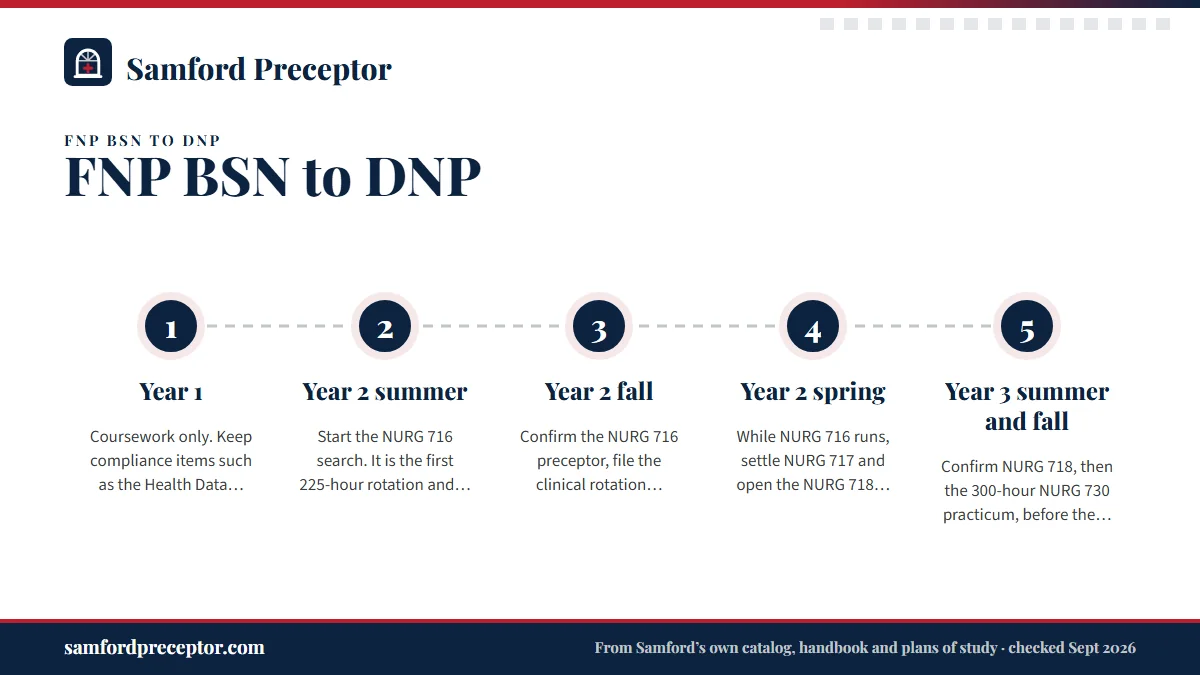
Samford does not publish lead times for NP rotation requests; they are kept in the NP Clinical Manual, which students reach through the Homeroom course in Canvas. A new site may need a new affiliation agreement, and some Alabama systems close student requests a semester ahead. A timeline we suggest for May starters:
- Year 1Coursework only. Keep compliance items such as the Health Data Record and the AHA BLS card up to date, and note any clinicians you already know who could precept.
- Year 2 summerStart the
NURG 716search. It is the first 225-hour rotation and the one most affected by agreement and request lead times. - Year 2 fallConfirm the
NURG 716preceptor, file the clinical rotation request, and begin theNURG 717search for the following summer. - Year 2 springWhile
NURG 716runs, settleNURG 717and open theNURG 718search. - Year 3 summer and fallConfirm
NURG 718, then the 300-hourNURG 730practicum, before the fall project work inNURG 760peaks.
How we support Samford BSN to DNP students
On Samford's account, connections are what open clinical doors close to home. A BSN to DNP student needs four of those doors in a row, and opening them is exactly the work we take on.
We run one search ahead of each clinical course, look for preceptors with the capacity for 225 and 300-hour semesters, and put together the preceptor and site information each clinical rotation request calls for. Where a site needs a new affiliation agreement, we start early enough for it to clear. If a preceptor has to step away mid-sequence, we find the replacement quickly so the next course still starts on time. Send your cohort year and location through the placement request form.
Questions Samford students ask
How is Samford's FNP BSN to DNP different from the FNP MSN?
The DNP takes three years instead of six semesters, carries 74 plan credits instead of 47 and requires 1,050 clinical hours instead of 750. It uses NURG 716, NURG 717 and NURG 718 in place of NURG 723 and NURG 724, adds doctoral leadership courses and the DNP Project, and shares the final NURG 730 practicum. See the FNP MSN page to compare.
Can I take longer than three years to finish?
The plan of study is built as three years, and Samford's handbook sets full-time study at 6 credits in fall and spring and 3 in summer. Graduate nursing students must finish within four years, and a petition can extend that to five. Any change to the sequence goes through your program coordinator, because the clinical courses run in a fixed order.
Which certification exam do BSN to DNP graduates take?
The same as other Samford FNP graduates: ANCC and/or AANPCB, according to Samford's FNP pages. The one result Samford publishes, for 2024 on the AANP exam, is 100% for its FNP graduates. The DNP does not change the certification path, which runs through the family nurse practitioner credential.
Can my DNP Project happen at my clinical site?
Samford's public pages do not say whether the project must, may or should share a site with a clinical course. The handbook covers only the structure: the proposal in NURG 760 and completion in NURG 761. If a practice might host both, raise it with your project faculty and course faculty early, before either plan is set.
What happens if I fall short of hours in one of the clinical semesters?
Samford's Incomplete rule requires most of the course, around half or more, done with a passing grade, and a request before the final exam. The rest must be finished the following term or it becomes an F, and an Incomplete blocks progression without your coordinator's permission. With four clinical courses back to back, a shortfall ripples forward; see behind on clinical hours.
Related pages
Last checked 2026-09-25
We check these pages against Samford's own program pages, plans of study, the 2026-27 Graduate Nursing Student Handbook and Alabama rules. Your course, your program coordinator and Graduate Student Services have the final word.
Samford says connections are essential. We are the connection.
Tell us your Samford track, where you live and when your next clinical course starts. We find preceptors near you who fit the course and prepare the details Samford needs to approve the rotation, including a new affiliation agreement where one is needed.
- Preceptors matched to the course: adult primary care for
NURG 723, family practice across the lifespan forNURG 724, psychiatric care forNURG 788 - Preceptor, license and site details ready for your clinical rotation request
- In your own community, anywhere Samford accepts you and your RN license is valid
Start your placement plan
Program, city and start date is all we need to begin.