FNP BSN to DNP clinicals: NURG 716, 717, 718 and 730
Samford's FNP BSN to DNP plan of study puts 1,050 clinical hours into four courses over four straight semesters, from spring of year two to spring of year three. The program's web page still says a minimum of 750, so plan placements for the larger figure and confirm it with your program coordinator.
Map all four DNP clinicals
Tell us your start year and where you live. A placement advisor plans preceptors near you for NURG 716, 717, 718 and 730 as one sequence.
The four clinical courses
The plan of study dated December 5, 2025 lists these clinical courses. The first three belong to this track alone; the fourth, NURG 730, is the practicum every Samford FNP finishes with.
| Course | Name in the plan | Credits | Hours | Semester | Also that term |
|---|---|---|---|---|---|
NURG 716 | FNP Clinical I | 3 in the plan, 4 in the catalog | 225 | Year 2 spring | NURG 714 Care in the Community, NURG 734 Essentials of Population Health |
NURG 717 | FNP Clinical II | 3 in the plan, 4 in the catalog | 225 | Year 3 summer | NURG 781 Leadership, Organizational and Strategic Management Theory |
NURG 718 | FNP Clinical III | 4 | 300 | Year 3 fall | NURG 760 DNP Project I, NURG 783 Business Skills and Principles for APN |
NURG 730 | NP Practicum | 6 | 300 | Year 3 spring, campus visit marked | NURG 761 DNP Project II |
Credits differ between sources as well. The plan gives NURG 716 and NURG 717 3 credits each for a 74-credit program, while the catalog lists 4 each and 76 in total. The hours appear only in the plan; the catalog leaves them out.
1,050 or 750: two Samford figures
The FNP DNP program page carries the sentence Samford uses on every NP page, a minimum of 750 clinical hours. The plan of study for the same track totals 1,050. Both are current Samford documents, so the conflict is real rather than a misreading.
The larger figure lines up with the rest of Samford's rules. Under the 2026-27 Graduate Nursing Student Handbook, every DNP needs at least 1,000 hours of supervised advanced practice after the bachelor's degree, and students who arrive without APRN preparation may have courses added to get there. A BSN-entry student with 750 hours would sit below that line. The DNP hours guide covers the rule, and the 750-hour breakdown shows where the shared figure comes from.
Plan placements for 1,050 hours across four courses. If your program coordinator confirms a different figure for your cohort, keep that answer in writing before you shorten any rotation.
Four semesters in a row
Clinical hours run through four back-to-back terms with no semester off to catch up. On the 2026-27 calendar pattern, spring runs about 15 weeks, the graduate summer term 12, and fall about 15. The weekly figures below are our arithmetic, with each course's hours spread evenly across its term.
| Course | Hours | Term | Even weekly load |
|---|---|---|---|
NURG 716 | 225 | Spring, about 15 weeks | About 15 |
NURG 717 | 225 | Summer, 12 weeks | About 19 |
NURG 718 | 300 | Fall, about 15 weeks | About 20 |
NURG 730 | 300 | Spring, about 15 weeks | About 20 to 21 |
NURG 717 is the squeeze: the same 225 hours as the spring course packed into a shorter summer, near the top of Samford's 10 to 20 hour range. On the current calendar pattern, summer ends in early August and fall begins in late August, so the NURG 718 preceptor has to be ready almost at once.
Intensives and the DNP project
The plan marks three campus visits: year one fall with NURG 610 Advanced Health Assessment, year two fall with NURG 600 Common Diagnostics and Procedures, and year three spring alongside NURG 730. The current program page lists 2 to 3 required intensives, while a legacy BSN to DNP page still online says 3 required sessions of two to four days. The last visit lands in your heaviest clinical term, so give your practicum preceptor the dates early. The intensives guide covers planning.
The DNP project runs beside the last two clinicals: NURG 760 DNP Project I sits next to NURG 718 in the fall, and NURG 761 DNP Project II next to NURG 730 in spring. Map project deadlines against your clinic days at the start of each term, since both peak in the same weeks.
Which preceptors fit which course
The plan names these courses FNP Clinical I, II and III without spelling out a patient focus for each, so each syllabus and the NP Clinical Manual define it. What the sequence makes plain is scale. By our arithmetic, 1,050 hours is 40 percent more than the 750 in the other FNP tracks, spread across more terms, so you need more preceptor weeks and often more than one practice.
Workable ways to build four placements
- One family practice for two or three courses in a row, keeping a single agreement and approval in place.
- An adult-focused practice early and a site that sees children later, so the lifespan is covered before the practicum.
- A final practicum site chosen for patient volume and for where you plan to work after graduation.
Timing your search
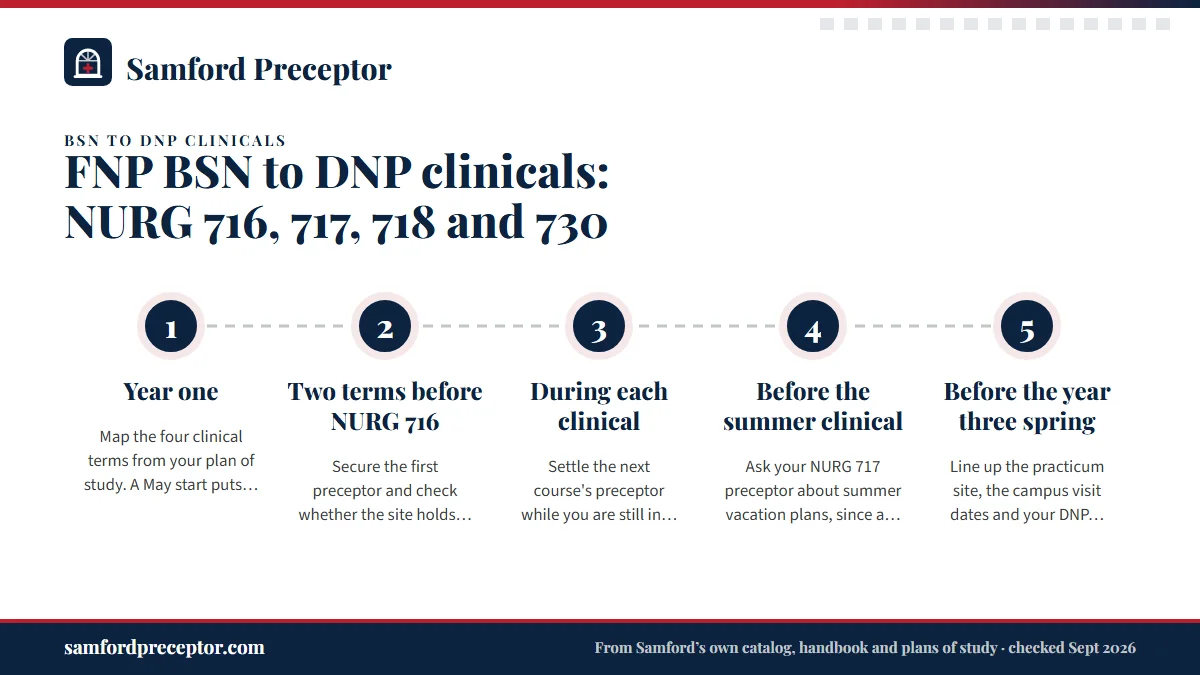
- Year oneMap the four clinical terms from your plan of study. A May start puts
NURG 716about 20 months out, in your second spring. - Two terms before NURG 716Secure the first preceptor and check whether the site holds a Samford affiliation agreement. If it has none, ask about a new one now; affiliation agreements explains the request.
- During each clinicalSettle the next course's preceptor while you are still in the current one, with extra care before the turn from summer to fall.
- Before the summer clinicalAsk your
NURG 717preceptor about summer vacation plans, since a 12-week term leaves little room to make up lost weeks. - Before the year three springLine up the practicum site, the campus visit dates and your DNP project milestones together.
How we carry BSN to DNP students through 1,050 hours
The BSN to DNP needs more preceptor time than any other Samford FNP track, over four terms without a break. We treat the four placements as one plan: your placement advisor finds preceptors near home for NURG 716, NURG 717, NURG 718 and NURG 730, keeps you at one practice across courses when the preceptor agrees, and prepares what Samford needs for each rotation request and any new affiliation agreement.
Because NURG 717 and NURG 718 sit back to back with only a short break between them, we secure both before the summer term opens. If a preceptor drops in the middle of the run, we find the next one so the sequence keeps moving. Read the BSN to DNP program guide or send your start year through the request form.
Questions Samford students ask
Why does Samford's FNP DNP from the BSN need more hours than the MSN?
The DNP carries a rule the MSN does not: the graduate handbook wants 1,000 supervised hours of advanced practice after the bachelor's degree. MSN to DNP students can apply up to 500 hours from their master's, but BSN-entry students start at zero, so the plan builds 1,050 hours into the clinical courses themselves.
Can I slow down the BSN to DNP clinical sequence?
The plan places the four clinical courses in consecutive terms, and any change to that order goes through your program coordinator as a plan of study change. Samford allows four years to finish a graduate nursing program, with a fifth on petition, so a slower path exists on paper, but each change moves every later clinical course with it.
Does NURG 709 Advanced Clinical Reasoning count toward the 1,050?
No. The plan lists NURG 709 in the year two fall as a simulated course with no clinical hours. The 1,050 comes only from NURG 716, NURG 717, NURG 718 and NURG 730. The simulation work still prepares you for your first preceptor, who starts with you the following spring.
Do BSN to DNP students take NURG 723 and NURG 724?
Not in the current plan. The BSN to DNP replaces those two courses with NURG 716, NURG 717 and NURG 718, which carry 750 hours between them against 450 for the pair, then joins the other tracks for NURG 730. The NURG 730 guide applies to you as written.
Which Samford page for the FNP BSN to DNP is current?
Samford runs a current FNP DNP page and a legacy BSN to DNP page that is still online. The legacy page gives an April 15 deadline, 3 on-campus sessions and extra prerequisites; the current page gives March 1 and 2 to 3 intensives. Follow the current page and your plan of study, and ask Graduate Student Services when the two differ on something that affects you.
Related pages
Last checked 2026-09-25
We check these pages against Samford's own program pages, plans of study, the 2026-27 Graduate Nursing Student Handbook and Alabama rules. Your course, your program coordinator and Graduate Student Services have the final word.
Samford says connections are essential. We are the connection.
Tell us your Samford track, where you live and when your next clinical course starts. We find preceptors near you who fit the course and prepare the details Samford needs to approve the rotation, including a new affiliation agreement where one is needed.
- Preceptors matched to the course: adult primary care for
NURG 723, family practice across the lifespan forNURG 724, psychiatric care forNURG 788 - Preceptor, license and site details ready for your clinical rotation request
- In your own community, anywhere Samford accepts you and your RN license is valid
Start your placement plan
Program, city and start date is all we need to begin.