NURG 724 Advanced Practice Clinical II FNP: 300 hours across the lifespan
NURG 724 is the middle FNP clinical at Samford: 4 credits and 300 hours with patients across the lifespan, taken the fall after NURG 723. It doubles the summer course's hours and adds children and adolescents, which usually means a family practice that sees every age or a second site for pediatrics.
Plan your NURG 724 sites
Tell us your FNP track, your fall and where you live. A placement advisor finds lifespan preceptors near you, one site or two.
NURG 724, per Samford's plans of studyNURG 723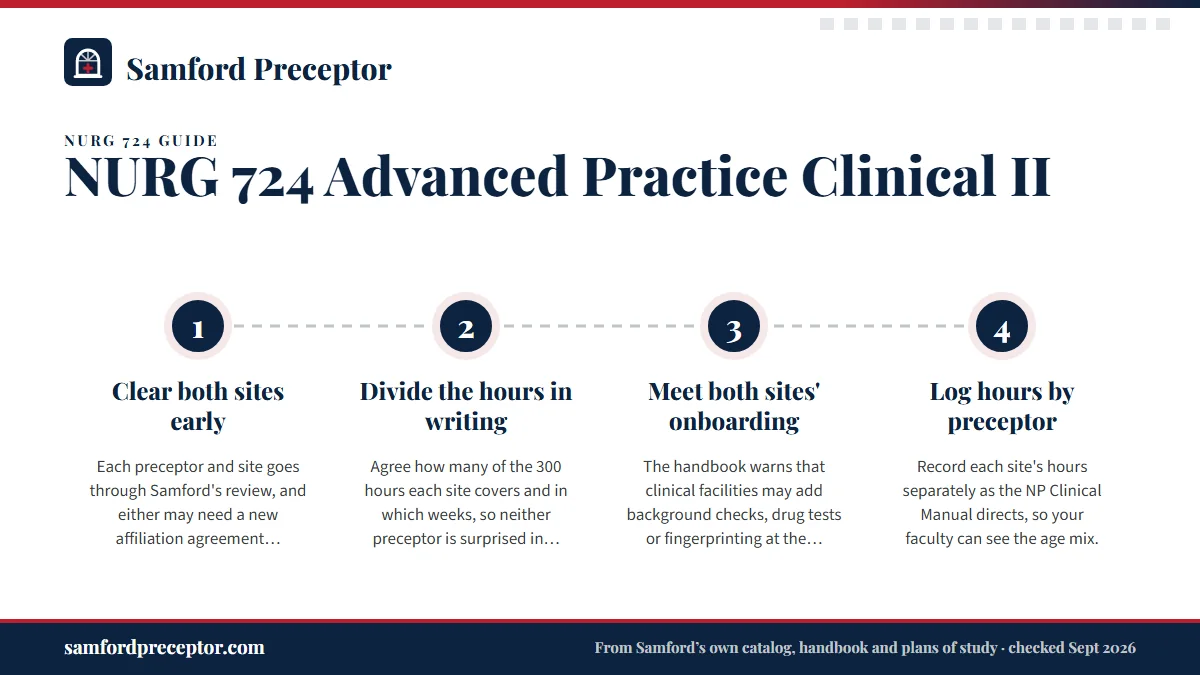
NURG 724 at a glance
The catalog lists the course as Advanced Practice Clinical II FNP and the plans as FNP Clinical: Across the Lifespan. Either way it is the step where the FNP load jumps: twice the hours of the summer course in a term only a few weeks longer. For most students it is also the first NP course with children on the schedule, so a preceptor at ease teaching pediatric visits is worth the extra search.
| Item | What Samford's documents show |
|---|---|
| Catalog name | Advanced Practice Clinical II FNP |
| Plan of study name | FNP Clinical: Across the Lifespan |
| Credits | 4 |
| Clinical hours | 300 (plans dated December 2025) |
| Patients | Across the lifespan |
| Tracks | FNP BSN to MSN, ADN to MSN, post-graduate certificate, MSN to DNP |
| Term | Fall, in every plan that includes it |
| Comes after | NURG 723, 150 hours, summer |
| Leads to | NURG 730 NP Practicum, 300 hours, spring |
When NURG 724 falls in each track
In three tracks the fall pairs this course with Family Primary Care III, the last primary care didactic course. ADN to MSN students reach it in year three, after the bridge courses, while BSN-entry and certificate students reach it in year two. MSN to DNP students took Family Primary Care III a year earlier and carry DNP Project I beside the clinical instead, so their fall balances 300 hours with the start of the project; the DNP hours guide covers the project courses.
| Track | NURG 724 semester | Also that fall |
|---|---|---|
| FNP BSN to MSN | Year 2 fall | NURG 708 Family Primary Care III |
| FNP ADN to MSN | Year 3 fall | NURG 708 Family Primary Care III |
| FNP post-graduate certificate | Year 2 fall | NURG 708 Family Primary Care III |
| FNP MSN to DNP | Year 3 fall | NURG 760 DNP Project I |
What across the lifespan means for your sites
Samford's plan title puts patients of every age in this course, and its NP pages describe all 750 program hours as care for patients across the lifespan. For NURG 724 that means children and adolescents as well as adults and older adults.
Samford publishes no current split by age group or specialty. An archived 2016 FNP page divided the program's hours among family practice, women's health and pediatrics, but that belonged to an older 720-hour curriculum. If a split applies today, the NP Clinical Manual will spell it out, so check it before you settle on a single site.
Site patterns that fit a lifespan course
- One family practice that sees newborns through older adults, with a preceptor who can give you two or three days a week.
- An adult practice for most of the term plus a pediatric office for a block of weeks.
- A community health center or rural health clinic with a mixed-age panel and one steady preceptor.
300 hours in one fall
The fall 2026 graduate term runs from August 24 to December 3, about 15 weeks. By our arithmetic that is 20 hours a week for 300 hours, the top of the 10 to 20 hour range on Samford's NP pages. Samford closes for Thanksgiving on November 26 and 27, and graduate programs may choose not to observe the October 12 and 13 fall break.
The load starts high, so a slow first two weeks leaves you chasing hours by November. Look for a preceptor schedule that gives you the full weekly load from the first week, and let your course faculty know about canceled clinic days while there is still time to replace them. A preceptor's own holiday plans in late November and early December deserve a question before you commit.
Two sites, one course
Splitting NURG 724 between an adult practice and a pediatric one is a workable way to cover the lifespan, and each extra site adds its own steps.
- Clear both sites earlyEach preceptor and site goes through Samford's review, and either may need a new affiliation agreement. Affiliation agreements covers the request.
- Divide the hours in writingAgree how many of the 300 hours each site covers and in which weeks, so neither preceptor is surprised in November.
- Meet both sites' onboardingThe handbook warns that clinical facilities may add background checks, drug tests or fingerprinting at the student's expense, and two sites can mean two sets. Background checks explains the rules.
- Log hours by preceptorRecord each site's hours separately as the NP Clinical Manual directs, so your faculty can see the age mix.
Starting the NURG 724 search during NURG 723
On Samford's current calendar pattern, summer classes end in early August and fall classes start in late August, about three weeks apart, so the fall preceptor has to be settled in spring, not in August. If your NURG 723 preceptor sees children, ask in the first weeks of summer whether they can keep you for fall; staying put avoids a second agreement and approval.
If not, begin the lifespan search before summer starts. If you plan to add a pediatric office, ask about its lead time for students on the first call, since its fall schedule may fill before yours is set. The NURG 723 guide covers the first course, and the NURG 730 guide the spring practicum that follows this one.
How we plan NURG 724 for Samford students
We look for a family practice in your community that sees every age, or pair an adult practice with a pediatric one when that suits your area better. Your placement advisor checks each preceptor's fall calendar against a 20-hour week, prepares the details Samford reviews for every site, and flags a needed affiliation agreement months ahead.
Through the term we stay reachable. If a preceptor pulls out in October, we find another site near you so the hours keep coming. As the fall winds down, the same advisor is already working on your NURG 730 practicum, so the spring search is underway well before Thanksgiving. Tell us your track and fall year through the request form.
Questions Samford students ask
Do I need a pediatric preceptor for NURG 724?
Not necessarily. Samford publishes no pediatric hour minimum for current FNP students, and a family practice that sees children can cover the lifespan on its own. If your adult site sees few young patients, a pediatric office for part of the term fills the gap. Check the NP Clinical Manual for any split your cohort must meet.
Can a pediatric nurse practitioner precept part of NURG 724?
Alabama's preceptor definition turns on an appropriate license and a population focus, and a pediatric nurse practitioner is focused on children, so a block of pediatric weeks with one fits the idea of a lifespan course. Samford reviews and approves each preceptor, so confirm the arrangement through the rotation request before you start.
Is NURG 724 harder to place than NURG 723?
It usually takes more planning. The preceptor has to see children as well as adults and give you about 20 hours a week through a fall term, and a split between two sites doubles the paperwork. Starting in spring, while you are still preparing for NURG 723, keeps the fall from arriving before the placement does.
Does NURG 724 require women's health hours?
No current Samford document we found sets a women's health requirement for FNP students. The archived 2016 curriculum carved out 120 women's health hours, but that plan has been replaced. If your cohort has one, the NP Clinical Manual in the Homeroom will state it, and a family practice that sees women of all ages often covers it anyway.
What happens if I am short of 300 hours in December?
Samford's graduate catalog allows an Incomplete for an emergency when most of the course is done with passing work, with the rest due the next term. The nursing handbook adds that an Incomplete keeps you out of the next course, here NURG 730, unless your program coordinator or the graduate associate dean signs off. Behind on hours covers the steps.
Related pages
Last checked 2026-09-25
We check these pages against Samford's own program pages, plans of study, the 2026-27 Graduate Nursing Student Handbook and Alabama rules. Your course, your program coordinator and Graduate Student Services have the final word.
Samford says connections are essential. We are the connection.
Tell us your Samford track, where you live and when your next clinical course starts. We find preceptors near you who fit the course and prepare the details Samford needs to approve the rotation, including a new affiliation agreement where one is needed.
- Preceptors matched to the course: adult primary care for
NURG 723, family practice across the lifespan forNURG 724, psychiatric care forNURG 788 - Preceptor, license and site details ready for your clinical rotation request
- In your own community, anywhere Samford accepts you and your RN license is valid
Start your placement plan
Program, city and start date is all we need to begin.