Background checks and drug testing for Samford graduate nursing students
Samford asks each graduate nursing student to complete a background check and take part in random drug testing, both handled by a vendor the school contracts. Clinical sites may add their own checks, drug screens or fingerprinting at your expense. Getting this right matters: the handbook links ineligibility at the school's contracted clinical agencies to a failed course and dismissal.
Plan a rotation around your site's screening
Tell us your program and next clinical term. We find out what each proposed site screens for before you commit.
What Samford's handbook requires
The 2026-2027 Graduate Nursing Student Handbook covers screening in a handful of short passages. Put together, they say:
- You submit to a background check and to random drug testing as part of clinical eligibility.
- Clinical facilities may require further background checks, drug tests and fingerprinting, and those are at your expense.
- You pay all costs of obtaining the background check itself.
- The cost of random drug screening is built into your student safety fee.
- The school uses a compliance vendor for specimen collection and screening, and the handbook's consent form refers to the school's contracted compliance company.
Screening is one part of a longer clearance file; the full compliance list shows where it fits alongside immunizations, BLS and insurance.
Which company runs the screening
The current graduate handbook does not name its compliance vendor, and this page follows Samford's lead. Older graduate handbooks named a company, and Samford's undergraduate and nurse anesthesia handbooks describe systems of their own, but none of those tell you who handles graduate screening today.
Use the instructions Samford sends you, not a name from an old handbook, a classmate in another program or a search result. If nothing has reached your Samford email before your first clinical term, ask Graduate Student Services, where one staff role covers compliance; who does what maps the other offices.
The same goes for where results are stored and who sees them. Those details come with Samford's instructions, and the consent form in the handbook is the place to read what you are agreeing to before you sign.
Random testing and testing for cause
Random testing is not tied to one date the way an admission background check is. The handbook publishes no schedule or frequency, and because its cost sits inside the safety fee, you are not billed test by test.
The handbook also sets out a for-cause procedure. Its first step: when a faculty member or designated preceptor notices suspicious behavior, they have another health care provider confirm it. Apart from testing, faculty hold the authority to send a student home from a clinical site if the student's conduct raises doubts about patient safety.
Your preceptor has a defined part in that procedure, so it is worth knowing it exists before your first clinical day. It is one more reason Samford reviews and approves every preceptor who supervises its students.
Extra checks that clinical sites add
Samford's screening is the baseline; the site's screening is the gate. The handbook warns that facilities may require their own background checks, drug tests and fingerprinting at the student's expense, and the site sets the timing.
Flowers Hospital in Dothan shows how this works. Its student instructions, preserved in an archived copy, have students submit an online application first, then deliver a drug screen, a background check, a BLS card and vaccine records to the hospital's HR team no later than seven days before they start. Other systems fold screening into their own orientation steps.
Plan for the time as well as the cost. Ask each site at the start what it runs, how recent results must be and who receives them. Screening also returns after graduation: Samford's consumer information notes that state licensure can involve background checks and fingerprinting, so keep copies of everything you submit.
What ineligibility means
This is the rule that makes screening serious. In the handbook's terms, a student deemed ineligible for clinical placement in any of the school's contracted agencies fails the course and is dismissed from nursing.
The handbook does not list which findings make a student ineligible; agencies apply their own standards. That is why the time to raise a concern is before a clinical rotation request goes in, not after a site's check comes back. Talk with your program coordinator or Graduate Student Services early.
Worth raising before your first rotation
- Anything on your record you expect a background check to show.
- Any prescribed medication that could appear on a drug screen, and how Samford wants it documented.
- Any license action, past or pending, in any state; your RN license must be unencumbered, as the license page explains.
Let Samford hear it from you first. A question raised early leaves room for options; a surprise at a site's check leaves very little.
How we keep screening from delaying your rotation
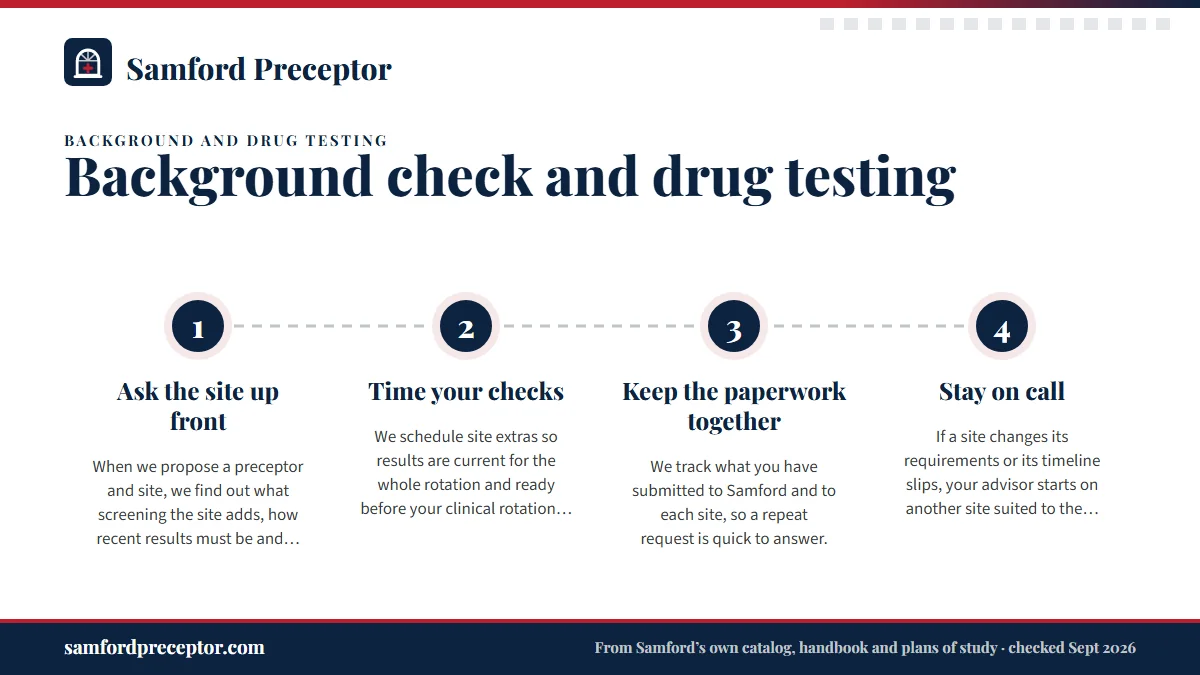
Samford students rely on us to see a site's requirements before they turn into deadlines. Your placement advisor treats screening as part of choosing the site, not a step to discover afterward.
- Ask the site up frontWhen we propose a preceptor and site, we find out what screening the site adds, how recent results must be and how long its process takes.
- Time your checksWe schedule site extras so results are current for the whole rotation and ready before your clinical rotation request needs them.
- Keep the paperwork togetherWe track what you have submitted to Samford and to each site, so a repeat request is quick to answer.
- Stay on callIf a site changes its requirements or its timeline slips, your advisor starts on another site suited to the same course.
Questions Samford students ask
Who pays for background checks in Samford nursing programs?
You do. Samford's handbook puts all costs of the background check on the student, and any extra checks, drug tests or fingerprinting a clinical facility requires are also at the student's expense. Random drug screening is the exception: its cost is included in the student safety fee.
How often does Samford drug test graduate nursing students?
The handbook calls the testing random and gives no schedule. It also describes testing for cause, which starts when faculty or a designated preceptor sees suspicious behavior and has another provider confirm it. Clinical sites can require their own screens too, so a student may test more than once in a single term.
Which company does Samford use for graduate drug testing?
The 2026-2027 Graduate Nursing Student Handbook does not name one; it refers to the school's contracted compliance company. Samford sends enrolled students the instructions they need. Follow those rather than a company named in an older handbook or used by a different Samford program.
Will an old charge keep me out of Samford clinicals?
Samford does not publish a list of disqualifying findings, and each clinical agency applies its own standards. What the handbook does say is that ineligibility for placement with the school's contracted agencies leads to course failure and dismissal. Raise anything you expect a check to show with your program coordinator or Graduate Student Services before a rotation is requested.
Do Samford nursing students need fingerprints?
Only when a clinical facility requires them, according to the handbook, and then at your own expense. Fingerprinting can also be part of state licensure after graduation. Ask each site about fingerprints as soon as it is proposed, since it adds an appointment to your onboarding.
Related pages
Last checked 2026-09-25
We check these pages against Samford's own program pages, plans of study, the 2026-27 Graduate Nursing Student Handbook and Alabama rules. Your course, your program coordinator and Graduate Student Services have the final word.
Samford says connections are essential. We are the connection.
Tell us your Samford track, where you live and when your next clinical course starts. We find preceptors near you who fit the course and prepare the details Samford needs to approve the rotation, including a new affiliation agreement where one is needed.
- Preceptors matched to the course: adult primary care for
NURG 723, family practice across the lifespan forNURG 724, psychiatric care forNURG 788 - Preceptor, license and site details ready for your clinical rotation request
- In your own community, anywhere Samford accepts you and your RN license is valid
Start your placement plan
Program, city and start date is all we need to begin.