Samford's Nurse Anesthesia DNP: assigned clinical sites, hours and what to plan
In Samford's Nurse Anesthesia DNP, the program assigns every clinical site, often out of town, so students do not search for anesthesia preceptors. What you control is readiness: a multistate RN license, current certifications, clean compliance records, and a life arranged for four semesters of rotations that may be far from Birmingham.
Plan your anesthesia clinical years
Ask the placement desk about license timing, compliance dates or getting ready for out-of-town rotations.
How the 36 months are laid out
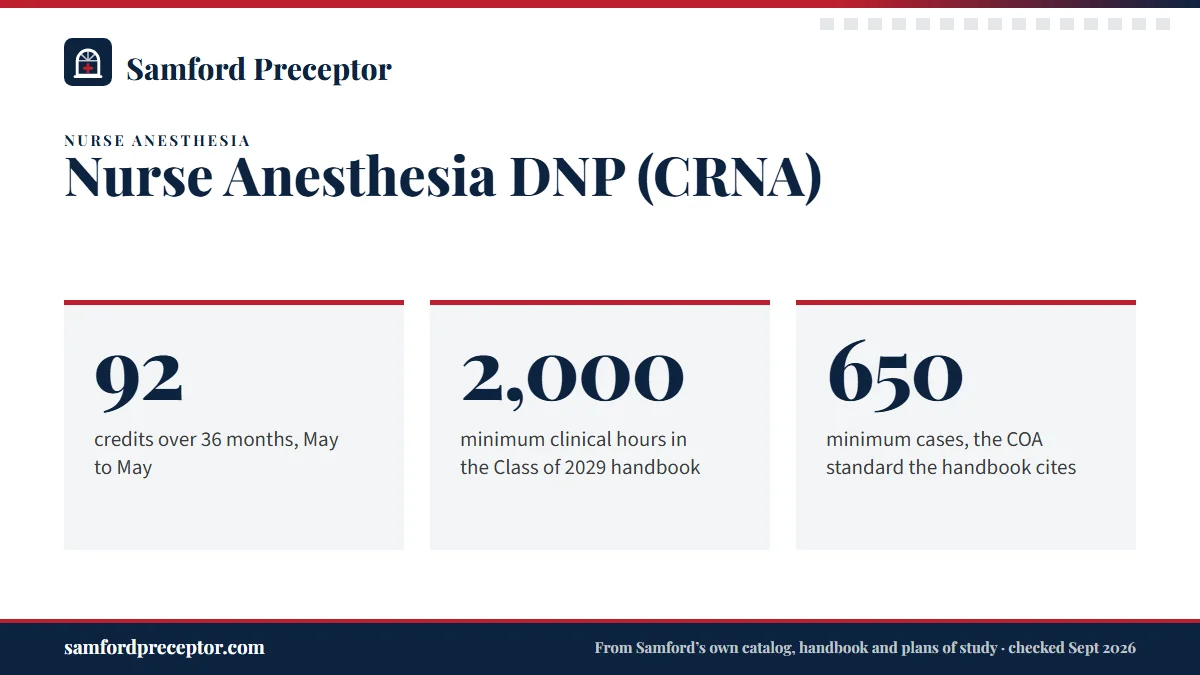
Samford describes a "36-month, 92-credit course of study" of nine semesters, May to May, full time only. The shape is three blocks: "the first two semesters online, the next three semesters in-person and the final four semesters in clinical rotations." Students come to campus in January of the third semester to begin face-to-face classes.
| Semester | Where | Clinical and project courses |
|---|---|---|
| 1 summer, 2 fall | Online | None; APN core courses NUNA 731 to NUNA 734 |
| 3 spring, 4 summer, 5 fall | On campus in Birmingham | None; anesthesia science and principles |
| 6 spring | Clinical rotations | NUNA 790 Clinical Practicum I with NUNA 750 Seminar I |
| 7 summer | Clinical rotations | NUNA 791 Clinical Practicum II, NUNA 751, NUNA 760 DNP Project I |
| 8 fall | Clinical rotations | NUNA 792 Clinical Practicum III, NUNA 752, NUNA 761 DNP Project II |
| 9 spring | Clinical rotations | NUNA 793 Clinical Practicum IV with NUNA 753 Seminar IV |
Each clinical practicum carries 7 credits. Samford does not publish the hours inside each NUNA 790 to NUNA 793 course, only the program totals below.
Who places you, and where
Placement here is Samford's job, and the handbook says so directly: "Students will be assigned to several 'out of town' clinical sites. Clinical sites may be a significant distance from the Samford University campus." The program page describes "metropolitan and rural sites with varying practice models."
The Director of Clinical Services (the DCS) issues the clinical schedules for semesters six through nine during semester five. At each site, a Clinical Coordinator assigns surgical cases based on student need and confirms that every preceptor is a licensed registered nurse certified through NBCRNA. Supervision is limited to CRNAs and anesthesiologists with staff privileges who are immediately available, at no more than two students per preceptor.
Changes go through a Schedule Change Request Form in Canvas. If a site requires a vaccine or test you decline, the handbook lets you opt out of that site and ask the DCS to look for a comparable experience, while stating plainly that Samford makes no representation an alternative will be available.
Spend your online year on the license, certifications and compliance items the handbook ties to your clinical start, not on hunting for anesthesia preceptors. Samford assigns every site.
Hours, cases and the weekly limits
The Class of 2029 handbook sets a minimum of 2,000 clinical hours and 650 total cases. Its milestone chart runs through rotations one to nine toward "1800-2000+ CLINICAL HOURS," and it lets clinical end once "2200 clinical hours are reached" and every other requirement is met, so read the numbers as a floor with a ceiling above it. Samford reports average case counts of 804 for the Class of 2025 and 759 for the Class of 2026.
Clinical life includes call. The program limits your commitment to less than 64 hours a week on average, and no single stretch of patient care may run past 16 hours.
Everything is logged in Typhon. Cases and experiences should be recorded at least weekly; preceptors complete a daily evaluation through their own Typhon link, and paper evaluations are not accepted. At the end of each rotation you evaluate at least three clinical preceptors and the site itself.
License, certifications and compliance
What the handbook ties to clinical readiness
- A current, unencumbered multistate RN license by the January 31 date the handbook sets; it says a multistate license is required to obtain all case requirements, and every state license must stay current for in-state and out-of-state rotations. RN license rules covers the NP side for comparison.
- BLS, ACLS and PALS current before rotations begin. Samford provides the certification courses before clinical starts.
- An influenza vaccination in the second fall, before November.
- Compliance records kept in your Typhon account, which shows expiration dates. Registration for the next semester is held while compliance is incomplete.
- Liability coverage: the current handbook says Samford purchases liability insurance for all students in a clinical program, while an archived 2024-2025 catalog told nurse anesthesia students to buy their own coverage. Go by the current handbook and confirm with the program; the insurance page compares the graduate rules.
Admission facts that shape the clinical years
Applicants need a BSN or graduate nursing degree from an ACEN or CCNE program, at least one year of full-time critical care experience (CCU, CV recovery, MICU, neuro ICU, NICU, SICU, burn, trauma or PICU), a 3.0 GPA with chemistry and research at B or better, and a GRE from the last five years; the MAT is not accepted. Applications open December 1 and close May 1, followed by an on-campus interview.
Two of Samford's numbers disagree. The program page gives a cohort of 34 while its FAQ says about 32 per class. First-time certification results also differ by source: Samford reports 87 percent for the Class of 2025 on the program page and 96.9 percent for 2024 graduates on its distinctives page. Samford states the program is fully accredited by the COA, with the next review scheduled for Spring 2035 (accreditation details).
Samford's nurse anesthesia licensure disclosure, dated August 28, 2025, lists the track as meeting educational requirements in all 50 states and DC, with no states excluded, and Samford notes it has no out-of-state tuition.
Where our help fits for CRNA students
Because Samford places every anesthesia rotation, our role with CRNA students is planning, compliance and answers, around the placements Samford makes. It is focused work for a demanding program, and it starts well before semester six.
- A readiness calendar keyed to the handbook: the January 31 multistate license date, certification renewals, the second-fall flu shot and every Typhon expiration that could hold registration.
- Help reading your semester-five schedule once the DCS releases it: travel time between sites, where you will stay during out-of-town rotations, and what each site asks of students before the first day.
- Straight answers on handbook rules, from supervision ratios to the weekly hour cap, with the source page so you can confirm it with the program.
Questions go to the placement desk through the contact form. For who to ask inside Samford, see who does what.
Questions Samford students ask
Can I ask for a nurse anesthesia clinical site near my home?
Samford's handbook describes assigned sites, several of them out of town, with schedules for the four clinical semesters issued by the Director of Clinical Services during semester five. Changes go through the Schedule Change Request Form in Canvas. Samford publishes no process for requesting a home-area site, so raise any hardship with the DCS early.
Is Samford's nurse anesthesia program online?
Only at the start. The first two semesters, summer and fall, are online. From January of the third semester you attend face-to-face classes in Birmingham for three semesters, then spend the final four in clinical rotations. The program is full time throughout.
Who supervises Samford nurse anesthesia students in clinical?
CRNAs or anesthesiologists with staff privileges who are immediately available, at a ratio of no more than two students to one preceptor. Each site's Clinical Coordinator documents that preceptors are licensed registered nurses certified by NBCRNA, assigns cases by student need and helps orient students to the setting.
Does Samford accept CRNA students from outside Alabama?
Yes. The nurse anesthesia disclosure excludes no states and lists the track as meeting educational requirements for licensure in every state and DC. You will still need the multistate RN license the handbook requires, and the in-person semesters and rotations mean relocating for much of the program.
What is Typhon used for in Samford's CRNA program?
Three things: your case and experience logs, recorded at least weekly; the daily preceptor evaluations, completed through each preceptor's personal Typhon link, since paper forms are not accepted; and your compliance records, with expiration dates. An incomplete compliance record holds registration for the next semester, so check those dates before each term.
Related pages
Last checked 2026-09-25
We check these pages against Samford's own program pages, plans of study, the 2026-27 Graduate Nursing Student Handbook and Alabama rules. Your course, your program coordinator and Graduate Student Services have the final word.
Samford says connections are essential. We are the connection.
Tell us your Samford track, where you live and when your next clinical course starts. We find preceptors near you who fit the course and prepare the details Samford needs to approve the rotation, including a new affiliation agreement where one is needed.
- Preceptors matched to the course: adult primary care for
NURG 723, family practice across the lifespan forNURG 724, psychiatric care forNURG 788 - Preceptor, license and site details ready for your clinical rotation request
- In your own community, anywhere Samford accepts you and your RN license is valid
Start your placement plan
Program, city and start date is all we need to begin.