Samford nursing accreditation: CCNE through 2035 and COA for nurse anesthesia
The Commission on Collegiate Nursing Education (CCNE) accredits all four levels of Samford's nursing programs, baccalaureate, master's, DNP and post-graduate APRN certificate, through June 30, 2035. Nurse anesthesia also answers to COA, the specialty's accreditor, with its next review set for Spring 2035. Here is what each covers and where accreditation shows up in your clinical plan.
Get your placement plan
Tell us your Samford program and where you live. A placement advisor replies with preceptor and site options in your community that fit your Samford course.
Who accredits what at Samford
Three accreditors touch a Samford nursing degree. CCNE reviews the nursing programs themselves, COA reviews the nurse anesthesia program on top of that, and SACSCOC accredits Samford University as an institution. Samford's own accreditation page names the CCNE programs; the dates below come from CCNE's public directory.
| Accreditor | What it covers at Samford | Status |
|---|---|---|
| CCNE | Baccalaureate program (the campus BSN pathways) | Accredited through June 30, 2035 |
| CCNE | Master's program (FNP and PMHNP MSN, including ADN entry) | Accredited through June 30, 2035 |
| CCNE | Doctor of Nursing Practice program | Accredited through June 30, 2035 |
| CCNE | Post-graduate APRN certificate program (FNP and PMHNP) | Accredited through June 30, 2035 |
| COA | Nurse anesthesia DNP | Fully accredited; next review Spring 2035 |
| SACSCOC | Samford University | Institutional accreditation |
If you are in an online FNP or PMHNP track, your program sits under CCNE's master's, DNP or certificate listing. Online delivery and the short on-campus intensives do not change that status.
CCNE dates, program by program
CCNE's directory gives each Samford program its own history. The undergraduate and master's programs date back to 2000, the DNP to 2011 and the post-graduate APRN certificate to 2014. All four were last acted on together in November 2024, run to the same expiration date and share a single next on-site visit.
| Program | Initial accreditation | Most recent action | Expires | Next on-site |
|---|---|---|---|---|
| Baccalaureate | Mar 3, 2000 | Nov 6, 2024 | Jun 30, 2035 | Fall 2034 |
| Master's | Mar 3, 2000 | Nov 6, 2024 | Jun 30, 2035 | Fall 2034 |
| DNP | Apr 4, 2011 | Nov 6, 2024 | Jun 30, 2035 | Fall 2034 |
| Post-graduate APRN certificate | Nov 3, 2014 | Nov 6, 2024 | Jun 30, 2035 | Fall 2034 |
For a student starting an NP track in 2026 or 2027, every clinical course in the plan of study, through the final NURG 730 or NURG 790 practicum, falls inside the current accreditation term.
COA and the nurse anesthesia DNP
Samford describes its nurse anesthesia program as fully accredited by COA, with the next COA review scheduled for Spring 2035. The program's handbook sets the clinical floor at a minimum of 2,000 clinical hours and 650 total cases, and 650 is COA's own case minimum.
Samford reports that recent classes cleared the case minimum comfortably, averaging 804 cases for the Class of 2025 and 759 for the Class of 2026. Nurse anesthesia clinicals also work differently from the NP tracks: Samford assigns the sites, including several out-of-town rotations, and students log cases in Typhon.
Because the placements are school-assigned, our role for nurse anesthesia students is planning and compliance, not sourcing sites. The nurse anesthesia DNP page sets out the semester structure and what students plan for.
Where accreditation shows up in your clinical plan
Accreditation is not just a badge on the website. Several rules you meet as a Samford student trace straight back to it.
- DNP hours: Samford's handbook says CCNE requires at least 1,000 post-baccalaureate hours of supervised advanced clinical practice for the DNP, with up to 500 allowed from an MSN or certificate. That is why the FNP BSN to DNP plan carries more clinical hours than the MSN. See the DNP's 1,000 hours.
- Transfer credit: Samford accepts at most 12 graduate credits, and only from a CCNE, CNEA or ACEN accredited school, through a course substitution form with the syllabus and transcript attached.
- Admission: the FNP BSN to DNP expects your bachelor's to come from a school holding CCNE, CNEA or ACEN accreditation.
- Clinical standards: Alabama's APRN education rules expect supervised clinical experiences to follow national accreditation, certification and advanced practice standards for the role and population.
- Preceptor tax credit: Alabama's credit applies only to rotations for accredited CRNP, CNM and CRNA programs physically located in Alabama, which is part of why a Samford student can offer it to a rural Alabama preceptor. See the Alabama preceptor tax credit.
Alabama Board of Nursing approval
National accreditation is one half of Alabama's requirement. Rule 610-X-3-.08 says an Alabama distance-learning advanced practice program needs both Alabama Board of Nursing approval and accreditation from a national nursing accreditor recognized by the U.S. Department of Education. CCNE covers the second half; the Board is the place to confirm the first.
Being an Alabama program also spares Samford students one step. Schools based outside Alabama must file a letter of intent and gain Board approval before their students can do clinicals in the state. Samford, as a home-state program, is not in that category, so an Alabama preceptor does not have to wait on that approval for a Samford student.
After graduation, the Board's CRNP approval under chapter 610-X-9 asks for a master's or higher degree in advanced practice nursing, current national certification and a transcript. The Alabama Board of Nursing rules page explains the education rules in plain words.
Samford's other quality marks, in Samford's words
Samford's catalog says the school became the first program in Alabama to achieve national accreditation, in 1955, back when it was the hospital school the Birmingham Baptist Association founded in 1922; the program moved to Samford in 1973. Samford also reports National League for Nursing Center of Excellence designations in 2005, 2017 and 2021.
The College of Health Sciences' Experiential Learning and Simulation Center, a 22,000 square foot facility the Nurse Practitioner program uses, holds full accreditation in Teaching and Education from the Society for Simulation in Healthcare. Samford describes it as one of four accredited centers in Alabama.
These are Samford's own descriptions. The accreditation facts that govern your degree are the CCNE and COA listings above.
How to check it yourself, and how we use it
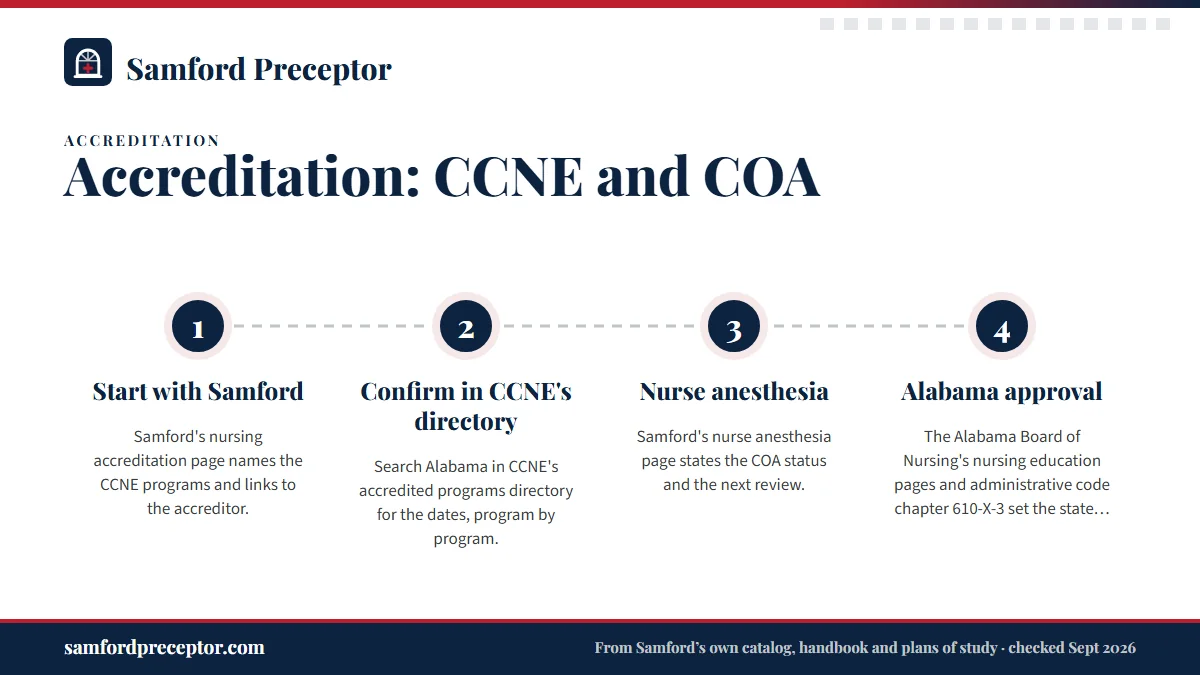
- Start with SamfordSamford's nursing accreditation page names the CCNE programs and links to the accreditor.
- Confirm in CCNE's directorySearch Alabama in CCNE's accredited programs directory for the dates, program by program.
- Nurse anesthesiaSamford's nurse anesthesia page states the COA status and the next review.
- Alabama approvalThe Alabama Board of Nursing's nursing education pages and administrative code chapter 610-X-3 set the state rules.
A preceptor weighing a semester with a student wants to know the program behind them. When we introduce a Samford student, the preceptor already has the program's CCNE standing, the course number and the hour target in hand, so the conversation starts at yes or no instead of at questions. Start a placement request to see how we prepare that introduction.
Questions Samford students ask
Is Samford's online FNP program accredited?
Yes. The FNP MSN tracks fall under CCNE's accreditation of Samford's master's program, the FNP DNP pathways under its DNP program, and the FNP certificate under its post-graduate APRN certificate program. All three run through June 30, 2035. Being online with short Birmingham intensives does not put the tracks in a different category.
Is Samford regionally accredited?
Samford University holds institutional accreditation from SACSCOC, which reviews the university as a whole. The nursing programs then carry their own specialized accreditation from CCNE, and nurse anesthesia adds COA. Institutional and nursing accreditation answer different questions, and a nursing student benefits from both.
What is the difference between CCNE and COA?
CCNE is a national accreditor for baccalaureate and graduate nursing programs, and it covers all four Samford nursing program levels. COA accredits nurse anesthesia programs specifically, and its standards include the 650-case minimum Samford's handbook cites for student anesthetists. At Samford, the nurse anesthesia DNP is the one program COA reviews.
Will my graduate credits from another school transfer to Samford?
Up to 12 graduate credits can transfer, and only from a school accredited by CCNE, CNEA or ACEN. You file a course substitution form with the course syllabus and your transcript, and the school decides course by course. Coursework from a school outside those three accreditors does not qualify for transfer.
Does accreditation mean Samford arranges NP clinical placements?
Accreditation measures program standards, not who sources each preceptor. Samford holds affiliation agreements with hundreds of agencies and approves every preceptor and site, while its NP pages ask students to bring personal and professional connections. The connections page explains how that works in practice.
Related pages
Last checked 2026-09-25
We check these pages against Samford's own program pages, plans of study, the 2026-27 Graduate Nursing Student Handbook and Alabama rules. Your course, your program coordinator and Graduate Student Services have the final word.
Samford says connections are essential. We are the connection.
Tell us your Samford track, where you live and when your next clinical course starts. We find preceptors near you who fit the course and prepare the details Samford needs to approve the rotation, including a new affiliation agreement where one is needed.
- Preceptors matched to the course: adult primary care for
NURG 723, family practice across the lifespan forNURG 724, psychiatric care forNURG 788 - Preceptor, license and site details ready for your clinical rotation request
- In your own community, anywhere Samford accepts you and your RN license is valid
Start your placement plan
Program, city and start date is all we need to begin.