The Alabama Preceptor Tax Incentive Program and Samford students
Alabama gives a state income tax credit to certain community-based preceptors who teach health professions students in medically underserved rural areas without being paid for that teaching. The credit counts only for rotations that support an eligible Alabama program registered with the Alabama Statewide AHEC Program Office. Samford is an Alabama school, but no public page confirms its registration, so a preceptor should ask before counting on the credit.
Get your placement plan
Tell us your Samford program and where you live. A placement advisor replies with preceptor and site options in your community that fit your Samford course.
What the program is
The Alabama Preceptor Tax Incentive Program, usually shortened to APTIP, comes from Act 2023-519 and sections 40-18-520 through 40-18-527 of the Code of Alabama. Section 40-18-523 provides a state income tax credit for community-based faculty preceptors who conduct qualifying, uncompensated clinical preceptorships in Alabama.
The Alabama Statewide AHEC Program Office runs the program. The Alabama Department of Revenue says the credit is available beginning with the 2024 tax year and expires on September 29, 2031, the same date the enabling sections of the Code are set to be repealed.
The credit is a set amount for each completed rotation, with an annual cap, and the statute sets a higher amount for physicians, dentists and optometrists than for nurse practitioners, nurse midwives, nurse anesthetists and physician assistants. A rotation is 160 hours of community-based clinical training, and a preceptor can claim up to twelve rotations a year. The current amounts are on the Alabama Department of Revenue page and the AHEC office's program page.
Who qualifies
Every condition below has to hold for a rotation to count. The statute and the AHEC office set them; Samford's own pages do not mention the program.
A rotation can count when
- The preceptor is a licensed physician, dentist, optometrist, nurse practitioner, certified nurse midwife, certified registered nurse anesthetist or physician assistant.
- The preceptor and the facility are both physically located in Alabama.
- The rotation takes place in a medically underserved rural area of Alabama.
- The preceptor receives no direct compensation for teaching from any source.
- The facility is not owned or operated by a nursing, medical or osteopathic school.
- The preceptor has registered with APTIP, which the AHEC office says every preceptor must do.
- The student's program is physically located in Alabama and registered with the Alabama Statewide AHEC Program Office.
For nurse practitioner preceptors the statute is precise: an Alabama-licensed certified registered nurse practitioner who provides the preceptorship through an agreement with a qualified nursing school physically located in the state, at a facility in Alabama.
Rural underserved sites: where the credit applies
Section 40-18-522 draws a firm line: a preceptorship may not be certified as eligible unless it is performed in a medically underserved rural area. An urban clinic does not qualify however strong the teaching, so much of the Birmingham metro sits outside the program.
Rural need in Alabama is well documented. HRSA's shortage area summary, as of June 30, 2026, counts 135 primary care and 67 mental health shortage designations in the state. The regional Area Health Education Centers include North Alabama AHEC in Huntsville, East Central AHEC in Gadsden, Black Belt AHEC in Livingston, Wiregrass AHEC in Dothan and Delta AHEC in Mobile.
Much of West Alabama beyond Tuscaloosa is rural and underserved. Whether a particular clinic's location qualifies is a question for the AHEC office, so a preceptor should confirm the site before the rotation starts. Our region guides for Tuscaloosa and West Alabama and Dothan and the Wiregrass list the health systems and AHEC center in each area.
How a rotation gets certified
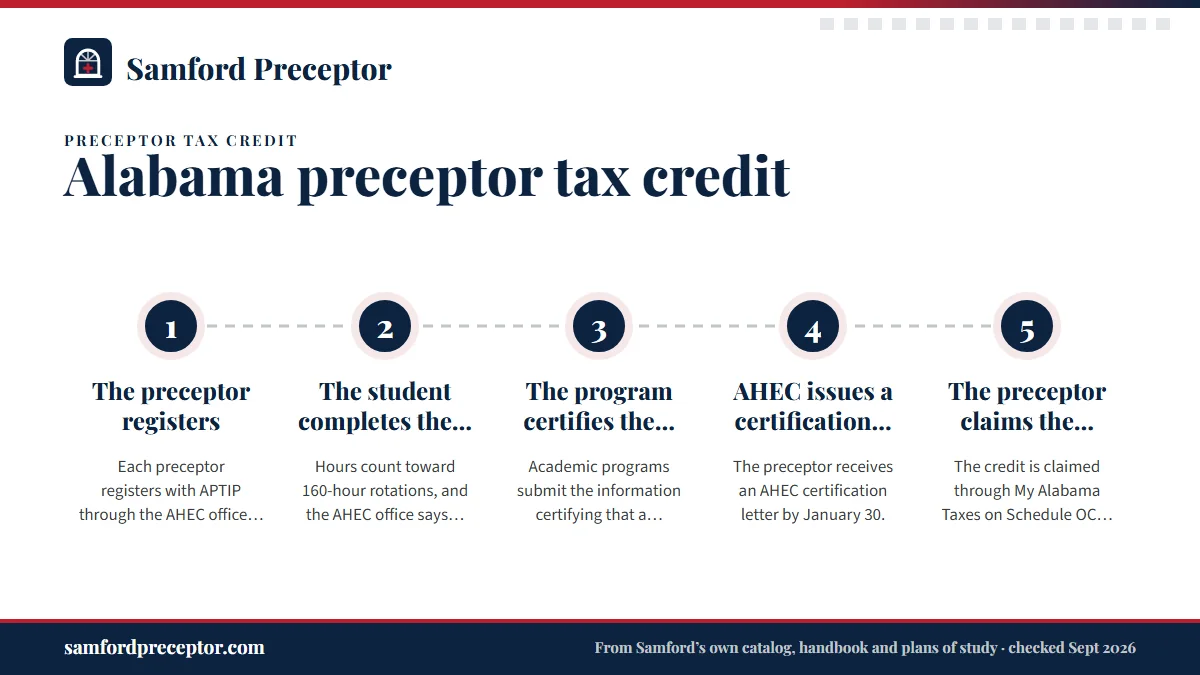
- The preceptor registersEach preceptor registers with APTIP through the AHEC office before any rotation can be claimed.
- The student completes the hoursHours count toward 160-hour rotations, and the AHEC office says hours add up across students and programs, within the twelve-rotation annual limit.
- The program certifies the rotationAcademic programs submit the information certifying that a student's rotation with the preceptor is complete. Preceptors do not submit rotation data themselves.
- AHEC issues a certification letterThe preceptor receives an AHEC certification letter by January 30.
- The preceptor claims the creditThe credit is claimed through My Alabama Taxes on Schedule OC, using the AHEC certificate. The AHEC office notes that there is no carry-over.
The third step is why the school's registration matters so much. Only the academic program can certify a student's rotation, so a program that is not registered with the AHEC office cannot certify anything, however well the other conditions line up.
Samford's registration: ask before you count on it
Samford sits in Homewood, in the Birmingham area, with CCNE-accredited nurse practitioner programs and a COA-accredited nurse anesthesia program. That matches the statute's description of a qualified health professions training program physically located in Alabama, and it separates Samford students from students of out-of-state online programs, whose rotations cannot count at all.
What no public source confirms is whether Samford has registered with the Alabama Statewide AHEC Program Office, and no Samford page mentions the program. Because eligibility runs through that registration, a preceptor who wants the credit should ask before the rotation begins: the AHEC office can answer, and so can Samford's nurse practitioner department, whose directory lists a Coordinator of Clinical Education. Students can raise the question with their program coordinator.
If the answer is yes, a rural Alabama preceptor hosting a Samford student can qualify on the same terms as for any registered program. Until that answer is in hand, describe the credit as a possibility to explore, not a settled benefit.
Samford clinical courses measured in 160-hour rotations
The AHEC office counts in 160-hour rotations, while Samford's plans of study set hours per course. The table converts each Samford clinical course. This is our arithmetic, not a Samford or AHEC figure, and only hours at a qualifying rural site would count.
| Course | Hours in Samford's plan | Full rotations | Hours beyond full rotations |
|---|---|---|---|
NURG 723 Advanced Practice Clinical I FNP | 150 | 0 | 150 |
NURG 724 Advanced Practice Clinical II FNP | 300 | 1 | 140 |
NURG 716 or NURG 717 FNP Clinical I or II | 225 | 1 | 65 |
NURG 718 FNP Clinical III | 300 | 1 | 140 |
NURG 730 NP Practicum | 300 | 1 | 140 |
NURG 767 Psychotherapeutic Frameworks | 75 in the plans; the catalog says at least 60 | 0 | 75 or fewer |
NURG 788 Advanced Practice Clinical I PMHNP | 150 | 0 | 150 |
NURG 789 Advanced Practice Clinical II PMHNP | 225 | 1 | 65 |
NURG 790 PMHNP Practicum | 300 | 1 | 140 |
Because hours combine across students and programs, a single short course is not a dead end. A rural preceptor who hosts one Samford student in NURG 723 and another in NURG 788 during the year reaches 300 hours, one full rotation with 140 hours toward the next, provided the program certifies them.
How we bring the credit into a preceptor conversation
Rural Alabama clinicians are some of the most valuable connections a Samford student can have, and building connections close to home is exactly what Samford's program pages ask of NP students; our page on Samford's connections line covers it. The placement desk reaches out to clinicians in your county, explains the credit in plain words, and is clear that it turns on the site, the preceptor's registration and the school's registration with AHEC.
We then prepare the preceptor's details for Samford's review, so the rotation request, any new affiliation agreement and the preceptor's APTIP questions move forward together. If you precept in Alabama and would host a Samford student, the preceptors page explains what is involved. Students can start a request with their course and term.
Questions Samford students ask
Can a preceptor outside Alabama claim the Alabama preceptor credit?
No. The preceptor and the facility both have to be physically located in Alabama, and the site has to be in a medically underserved rural area of the state. A Samford student rotating in Georgia or Tennessee can still find an excellent preceptor there, but that preceptor's hours fall outside this Alabama program.
Do nurse anesthesia preceptors qualify for APTIP?
Certified registered nurse anesthetists are on the list of eligible preceptors, and the statute covers nurse anesthetist programs. The same conditions apply: an Alabama site in a medically underserved rural area, no compensation for teaching, APTIP registration and a registered program. Samford assigns its nurse anesthesia clinical sites, so questions about those rotations go to the program.
Is the credit the same for physicians and nurse practitioners?
No. The statute sets one per-rotation amount and annual cap for physicians, dentists and optometrists, and a lower amount and cap for nurse practitioners, nurse midwives, nurse anesthetists and physician assistants. Both groups share the twelve-rotation annual limit. The Alabama Department of Revenue and the AHEC office publish the current figures.
How does a preceptor register with APTIP?
Registration runs through the Alabama Statewide AHEC Program Office, which administers the program from its APTIP page, and AHEC says every preceptor must register. Registration alone does not produce a credit: the rotation also needs a qualifying rural site and certification from an academic program registered with the same office.
When does the Alabama preceptor tax credit end?
The Alabama Department of Revenue says the credit began with the 2024 tax year and expires on September 29, 2031. Each rotation still has to meet every condition, including the rural site and the program's registration, and the preceptor claims it through My Alabama Taxes with the AHEC certificate.
Related pages
Last checked 2026-09-25
We check these pages against Samford's own program pages, plans of study, the 2026-27 Graduate Nursing Student Handbook and Alabama rules. Your course, your program coordinator and Graduate Student Services have the final word.
Samford says connections are essential. We are the connection.
Tell us your Samford track, where you live and when your next clinical course starts. We find preceptors near you who fit the course and prepare the details Samford needs to approve the rotation, including a new affiliation agreement where one is needed.
- Preceptors matched to the course: adult primary care for
NURG 723, family practice across the lifespan forNURG 724, psychiatric care forNURG 788 - Preceptor, license and site details ready for your clinical rotation request
- In your own community, anywhere Samford accepts you and your RN license is valid
Start your placement plan
Program, city and start date is all we need to begin.