Alabama nurse practitioner practice: collaboration, chapter 610-X-9 and your preceptor
Nurse practitioners in Alabama practice under a collaborative agreement with a physician, regulated jointly by the Board of Nursing and the State Board of Medical Examiners. On January 10, 2026, the rules on CRNP qualification and approval moved from chapter 610-X-5 to a new chapter, 610-X-9. This page explains how collaboration works, what it means for an Alabama clinician hosting a Samford student, and what you file after graduation.
Get your placement plan
Tell us your Samford program and where you live. A placement advisor replies with preceptor and site options in your community that fit your Samford course.
Alabama is a collaborative practice state
AANP's Alabama fact sheet, updated October 2025, classifies the state as reduced practice. Nurse practitioners must keep a regulated collaborative agreement with a physician for at least one element of practice, and the Alabama Board of Nursing and the State Board of Medical Examiners regulate that practice jointly. In Alabama's rules, a licensed nurse practitioner is a certified registered nurse practitioner, or CRNP.
Rule 610-X-5-.01(5) defines collaboration as a formal relationship between one or more CRNPs or certified nurse midwives and one or more physicians, shown through written protocols. The same rule says collaboration "does not require direct, on-site supervision," but it does require the medical oversight and direction that the two boards' rules call for.
A Joint Committee of the Board of Nursing and the State Board of Medical Examiners for Advanced Practice Nurses sits over the system. It recommends the rules, the model practice protocols and the formulary of legend drugs that CRNPs prescribe from, so both boards shape the rules your future practice will follow.
Where the rules live after January 10, 2026
The Board reorganized its advanced practice rules at the start of 2026. The rules in chapter 610-X-5 on CRNP qualification, application, authorization and temporary approval are marked repealed as of January 10, 2026. They now sit in chapter 610-X-9, Advanced Practice Nursing, published November 26, 2025 and amended effective July 13, 2026. Older citations, such as AANP's reference to 610-X-5-.03, now point to a repealed rule.
| Chapter | What it covers | When it matters to you |
|---|---|---|
| 610-X-3 | Nursing education programs and preceptor definitions | During every clinical course |
| 610-X-5 | Collaborative practice: protocols, physician duties, time limits | When you look at a preceptor's practice, and after licensure |
| 610-X-9 | CRNP qualification, application, title and approval | When you apply for approval after graduating |
| 540-X-8 (Board of Medical Examiners) | The collaborating physician's side of the agreement | When a future collaborating physician files |
Chapter 610-X-3 and its preceptor definition have their own page: Alabama Board of Nursing rules.
What collaboration requires in daily practice
Main duties under chapter 610-X-5
- A physician's collaborative agreements may not exceed a cumulative 360 hours of CRNP time per week, which the rule equates to nine full-time equivalents (rule .05(1)).
- For a CRNP with fewer than two years, or 4,000 hours, of collaborative practice, the physician must be present for at least 10 percent of the CRNP's scheduled hours at an approved practice site (rule .09(5)).
- The physician visits remote practice sites at least twice a year, meets at least quarterly with CRNPs who have more than two years of practice, and completes quarterly quality assurance with each CRNP.
- Each collaboration runs on a written standard protocol specific to the specialty practice area, signed by both the CRNP and the physician (rule .09(8)).
- The physician needs three years of practice, or one year plus board certification, completes collaborative-practice continuing education, and files a Commencement of Collaborative Practice form under the medical board's rules.
- CRNPs may prescribe legend drugs from the Joint Committee formulary under the signed protocol.
What it means for an Alabama clinician hosting you
An Alabama CRNP who precepts you practices inside a signed protocol with a collaborating physician, and that protocol is specific to a specialty practice area. It shapes which patients the practice sees and what care the CRNP provides, so ask about it before a rotation with a defined focus. A practice centered on adult primary care suits NURG 723; for NURG 724, which spans the lifespan, you want a practice that also sees children.
The collaborative practice chapter contains no rule on students, preceptors or clinical placements. What you do in the clinic comes from the Samford course itself, the NP Clinical Manual and the education chapter, 610-X-3, which names physicians among eligible advanced practice preceptors. A CRNP's collaborating physician is therefore another possible preceptor, subject to Samford's approval.
Chapter 610-X-5 says nothing about how experienced a preceptor must be; newer CRNPs simply work with closer physician presence for their first two years. Samford's own criteria are in the NP Clinical Manual, and our preceptor requirements guide covers what to confirm.
When the placement desk approaches an Alabama practice for you, we ask what its patient mix covers and match it to the Samford course before any details go to Samford, so the fit is settled before your rotation request is.
Primary care and psychiatric need in Alabama
HRSA's quarterly summary of health professional shortage areas, as of June 30, 2026, lists 135 primary care designations and 67 mental health designations in Alabama. HRSA estimates that the mental health designations meet 28.40 percent of need, against 62.97 percent for primary care.
Those figures describe the state's workforce, not Samford's clinical sites, but they explain the setting you are working in. Psychiatric clinicians are the scarcer group, and PMHNP students in NURG 788, NURG 789 and NURG 790 should treat that as a reason to start their preceptor search early. FNP students in rural counties face a similar picture in primary care.
Alabama also offers a state income tax credit to some preceptors who teach in medically underserved rural areas, which can make a rural practice more open to hosting a student from an Alabama program. The conditions are specific, including the school's registration with the state AHEC office; see the Alabama preceptor tax credit page before mentioning it to anyone.
After graduation: approval as a CRNP in Alabama
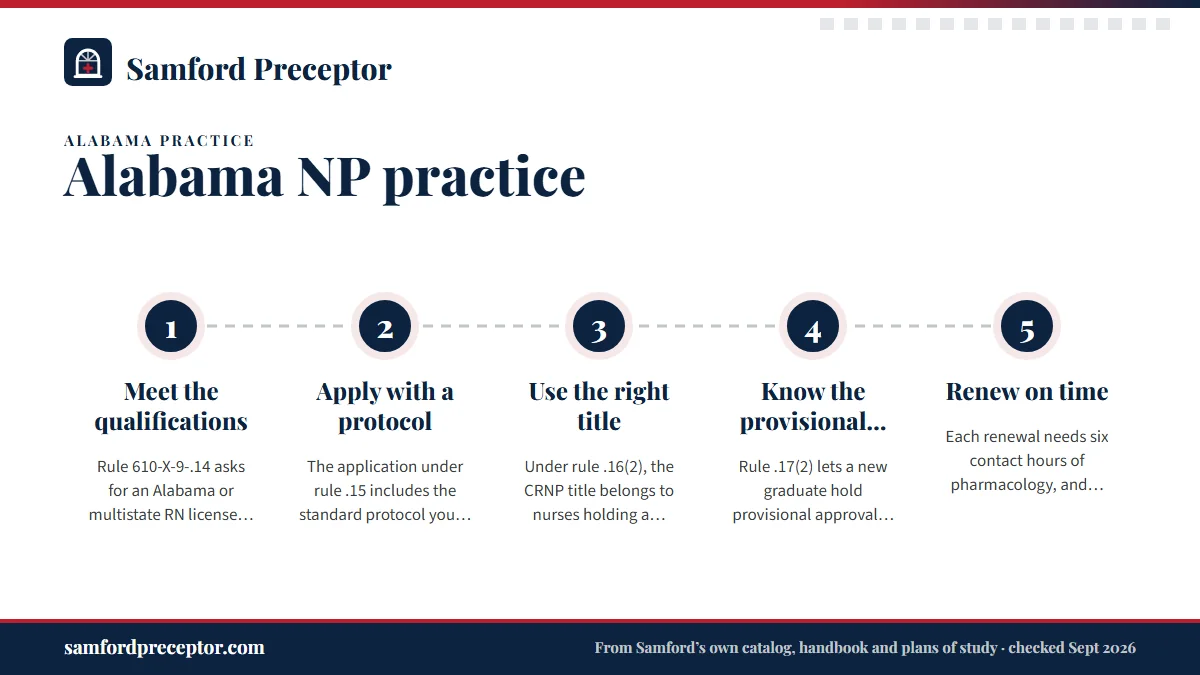
- Meet the qualificationsRule 610-X-9-.14 asks for an Alabama or multistate RN license, a master's or higher degree in advanced practice nursing, national certification as a nurse practitioner that is still current, and continuing education in collaborative practice.
- Apply with a protocolThe application under rule .15 includes the standard protocol you will follow with each collaborating physician, a transcript and proof of certification.
- Use the right titleUnder rule .16(2), the CRNP title belongs to nurses holding a certificate of qualification and current approval for collaborative practice in Alabama. Before approval, use only the title your national certifying agency grants.
- Know the provisional optionRule .17(2) lets a new graduate hold provisional approval before passing the certification exam. The title is Graduate Registered Nurse Practitioner, it lasts six months at most, and it requires an approved CRNP or a licensed physician supervising on site plus review of every patient case.
- Renew on timeEach renewal needs six contact hours of pharmacology, and approval ends when the RN license or the national certification expires, whichever comes first.
Holding a multistate RN license issued by another compact state does not replace this application; the Board says APRNs holding those licenses still apply for approval to practice advanced practice nursing in Alabama. As of September 25, 2026, the Board's advanced practice page also reports a cybersecurity event and a September 1 system outage, with initial CRNP approvals, new collaborations and reinstatements moved to paper applications for now. For the exam itself, see NP certification exams, and for Samford's post-graduate option, the nurse practitioner residency.
Questions Samford students ask
Do Alabama nurse practitioners need a physician on site?
Not as a general rule. Alabama's definition of collaboration does not require direct, on-site supervision. Two exceptions affect new graduates most: a physician must be present for at least 10 percent of scheduled hours when a CRNP has under two years of collaborative practice, and provisional Graduate Registered Nurse Practitioners work under on-site supervision until they pass certification.
Is Alabama part of the APRN Compact?
No. Alabama has not enacted the APRN Compact, which is not yet operating in any state. Alabama has belonged to the Nurse Licensure Compact for RNs since January 1, 2020, so a multistate RN license from a compact state covers the RN side of Alabama clinicals, while advanced practice approval stays a separate Alabama application.
How many nurse practitioners can one Alabama physician collaborate with?
Alabama caps time rather than headcount. A physician's collaborative agreements may not exceed a cumulative 360 hours of CRNP time per week, which the rule treats as nine full-time equivalents. A practice with part-time CRNPs can involve more than nine people, provided the combined weekly hours stay within that limit and every other duty in chapter 610-X-5 is met.
Does the 2026 rule change affect Samford students in clinical courses now?
Not directly. The January 2026 reorganization moved CRNP qualification, application and approval rules into chapter 610-X-9, and those apply once you graduate. Student clinical experiences stay under the education chapter, 610-X-3, and Samford's own course requirements, so your current rotation runs on the same footing as before.
What happens to CRNP approval if a collaborating physician leaves?
Approval is tied to the collaboration. Rule 610-X-9-.16(2) says that when the collaboration ends, approval is withdrawn automatically, so a new approved collaboration has to be in place before practicing again as a CRNP in Alabama. The Board handles new collaborations, and as of late September 2026 it is taking them on paper applications.
Related pages
Last checked 2026-09-25
We check these pages against Samford's own program pages, plans of study, the 2026-27 Graduate Nursing Student Handbook and Alabama rules. Your course, your program coordinator and Graduate Student Services have the final word.
Samford says connections are essential. We are the connection.
Tell us your Samford track, where you live and when your next clinical course starts. We find preceptors near you who fit the course and prepare the details Samford needs to approve the rotation, including a new affiliation agreement where one is needed.
- Preceptors matched to the course: adult primary care for
NURG 723, family practice across the lifespan forNURG 724, psychiatric care forNURG 788 - Preceptor, license and site details ready for your clinical rotation request
- In your own community, anywhere Samford accepts you and your RN license is valid
Start your placement plan
Program, city and start date is all we need to begin.