Samford's nurse practitioner residency: your first year of practice, not a student clinical
Samford runs a paid, 12-month primary care nurse practitioner residency for new FNP graduates and places each resident with a community-based clinical partner in Alabama, currently in Jefferson, Shelby and Pickens Counties. It begins after graduation. The preceptors for NURG 723, NURG 724 and NURG 730 still come through Samford's affiliation agreements, your clinical rotation requests and your connections.
Get your placement plan
Tell us your Samford program and where you live. A placement advisor replies with preceptor and site options in your community that fit your Samford course.
What the residency is
Samford's residencies page describes a paid, 12-month primary care nurse practitioner residency. It is a post-graduate program, not a degree and not a course in any plan of study. Residents are placed in community-based clinical partnerships in several Alabama counties, and Samford names its current partners' locations as Jefferson, Shelby and Pickens Counties.
Eligibility is narrow and clear: FNP graduates within 18 months of graduating who hold an Alabama or multistate license. A federal award from HRSA funds the program, and the school's directory lists a Director of Nurse Practitioner Residency among its faculty roles.
For 2026, Samford listed an application window of February 1 to September 30, 2026. With that window closing at the end of September, anyone graduating in 2027 should watch Samford's residencies page for the next cycle's dates rather than assume they repeat.
The residency is the one nurse practitioner placement Samford itself arranges, and it happens after you graduate. It is not a route to a preceptor for a current clinical course.
Residency versus student clinicals
Students sometimes read “Samford places residents with community partners” and assume the same applies to clinical courses. The two work in different ways, at different stages, under different rules.
| Student clinicals | NP residency | |
|---|---|---|
| When | During the program, in the later semesters of the plan of study | After graduation, within 18 months |
| Your role | Graduate nursing student under a preceptor | Paid resident in a first year of practice |
| Who sets up the site | Samford holds affiliation agreements and approves; students bring connections and may request new agreements | Samford places each resident with a community partner |
| Where | Your own community, anywhere Samford accepts you and your license is valid | Jefferson, Shelby and Pickens Counties, Alabama |
| License | Unencumbered RN license in your practice state and every clinical state | Alabama or multistate license |
| Length | 750 hours (1,050 in the FNP BSN to DNP) at 10 to 20 hours a week | 12 months |
| Tracks | FNP and PMHNP | FNP graduates |
The clinical placement process page walks through how the student side works, from connections to the clinical rotation request.
Why these three counties
Jefferson and Shelby Counties sit in the Birmingham metro, Samford's home region, alongside UAB Medicine, UAB St. Vincent's, Baptist Health and Children's of Alabama. Pickens County lies on the Mississippi line in West Alabama, a largely rural and underserved part of the state. Between them, the partner locations span metro and rural Alabama.
The need behind a primary care residency shows up in federal data. HRSA's shortage summary dated June 30, 2026 counts 135 primary care shortage designations in Alabama and puts the share of need met at 62.97%. That gap is the backdrop for a residency that keeps new FNPs practicing in Alabama communities.
If you are still a student and live in either area, the regional guides for the Birmingham metro and Tuscaloosa and West Alabama cover the health systems and student processes there. Rural West Alabama is also where a preceptor who takes a Samford student may qualify for Alabama's preceptor tax credit.
Eligibility and timing, step by step
Samford's page lists eligibility, not a selection process, so plan around the published conditions and confirm the rest with the residency program directly.
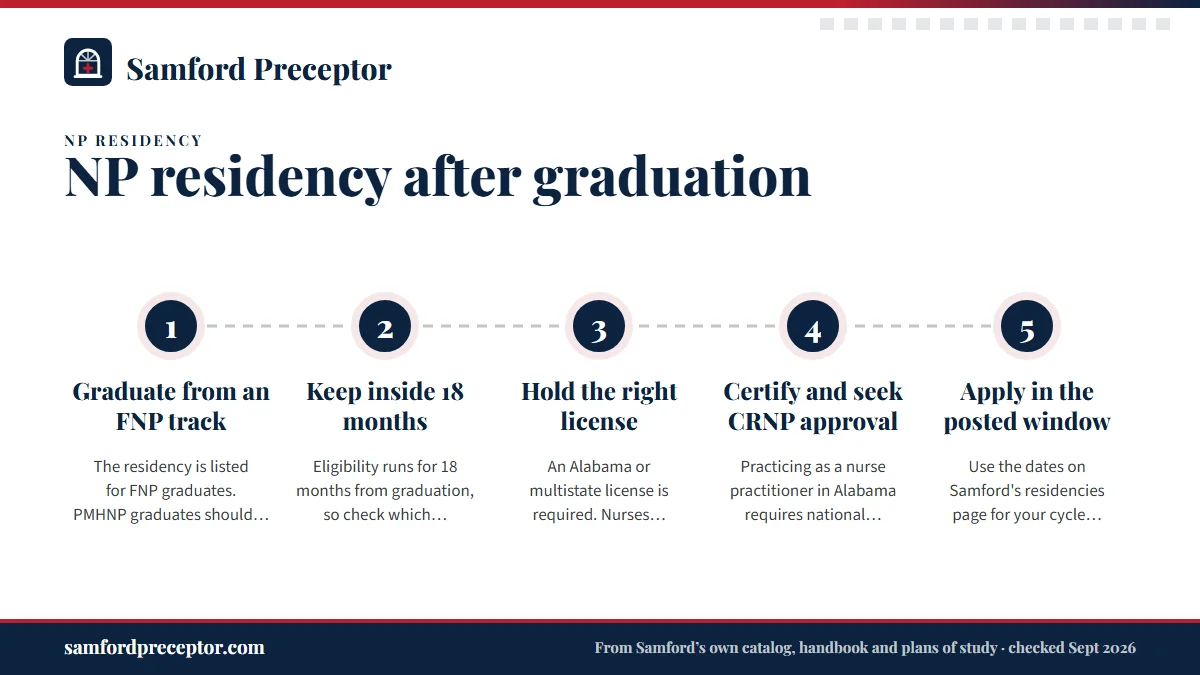
- Graduate from an FNP trackThe residency is listed for FNP graduates. PMHNP graduates should ask the program before assuming they qualify.
- Keep inside 18 monthsEligibility runs for 18 months from graduation, so check which application windows fall inside yours before you plan a start.
- Hold the right licenseAn Alabama or multistate license is required. Nurses licensed only in another single state will need to address that first.
- Certify and seek CRNP approvalPracticing as a nurse practitioner in Alabama requires national certification and Board approval for collaborative practice; the certification exams page covers that path.
- Apply in the posted windowUse the dates on Samford's residencies page for your cycle. The 2026 window ran from February 1 through September 30.
Clinicals that point toward primary care
If a primary care residency is part of your plan, the three FNP clinical courses are where that direction takes shape. NURG 723 focuses on adult patients over 150 hours, NURG 724 moves across the lifespan over 300 hours, and NURG 730 is the 300-hour practicum that closes the program.
Samford does not publish how residents are chosen, so no clinical setting is a formal requirement. Still, a student who has worked in family practice or community primary care during those courses arrives with the most relevant experience for a primary care year. The course pages for NURG 723 and NURG 724 explain what each asks of a preceptor.
BSN to DNP students take a different sequence, NURG 716, NURG 717, NURG 718 and NURG 730, and graduate with 1,050 clinical hours; the same logic about primary care settings applies.
Where we help, and where Samford leads
The residency is Samford's own program: you apply to it directly, and Samford makes the placement. Our work sits earlier, in the student years, the stage where, by Samford's own description, connections matter most for clinicals near home. That is the stage where a strong preceptor in the right setting shapes what you can show a residency later.
We bring those connections. For each clinical course we find a preceptor near you who fits the course, including primary care and family practice settings for students aiming at a residency like Samford's, and we prepare the details Samford needs to approve the rotation. If a preceptor steps away mid-semester, we find the replacement. Tell us your track and your next clinical course through the placement request form.
Questions Samford students ask
Can a current Samford student use the residency to find a clinical preceptor?
No. The residency takes graduates only, and a resident's placement is a paid year of practice, not a clinical course rotation. During the program, NP clinicals run through Samford's affiliation agreements, your clinical rotation requests and the connections you bring. That student stage is where our placement desk works.
Is Samford's NP residency open to PMHNP graduates?
Samford's residencies page lists FNP graduates within 18 months of graduation and describes a primary care residency, which fits the family track. It does not mention PMHNP graduates. If you are finishing the PMHNP track and want a supported first year, ask the residency program directly before you plan around it.
Do I have to be a Samford graduate to apply?
Samford's page frames eligibility by track, timing and license: an FNP graduate within 18 months holding an Alabama or multistate license. It does not say whether graduates of other schools qualify. Confirm with the residency program, especially if you finished your FNP elsewhere and moved to Alabama.
Are there other nurse practitioner residencies in Birmingham?
Yes. The Birmingham VA runs nurse practitioner residencies with the UAB School of Nursing, according to the VA's own trainee page, and it asks trainees to come through an affiliation agreement. That program is separate from Samford's, with its own eligibility and application process.
Does the residency count toward my DNP hours?
No. The residency starts after graduation, so it sits outside any Samford plan of study. DNP hours come from the clinical courses and the handbook's rules: the doctorate counts 1,000 hours after the bachelor's, of which an MSN or certificate can supply up to 500. The DNP hours page explains the count.
Related pages
Last checked 2026-09-25
We check these pages against Samford's own program pages, plans of study, the 2026-27 Graduate Nursing Student Handbook and Alabama rules. Your course, your program coordinator and Graduate Student Services have the final word.
Samford says connections are essential. We are the connection.
Tell us your Samford track, where you live and when your next clinical course starts. We find preceptors near you who fit the course and prepare the details Samford needs to approve the rotation, including a new affiliation agreement where one is needed.
- Preceptors matched to the course: adult primary care for
NURG 723, family practice across the lifespan forNURG 724, psychiatric care forNURG 788 - Preceptor, license and site details ready for your clinical rotation request
- In your own community, anywhere Samford accepts you and your RN license is valid
Start your placement plan
Program, city and start date is all we need to begin.