Alabama Board of Nursing rules behind Samford's NP clinicals
Samford's Moffett & Sanders School of Nursing is an Alabama program, so chapter 610-X-3 of the Alabama Board of Nursing's rules shapes how its nurse practitioner clinicals are built. The chapter defines who may precept an advanced practice student, sets duties for the program and its faculty, and treats in-state and out-of-state programs differently. Below is each rule in plain words, and what it means when you choose a preceptor.
Get your placement plan
Tell us your Samford program and where you live. A placement advisor replies with preceptor and site options in your community that fit your Samford course.
The chapter that covers Samford's nursing programs
The Alabama Board of Nursing publishes its rules in the Alabama Administrative Code. Chapter 610-X-3, Nursing Education Programs, carries a revision date of November 14, 2025, and it reaches every program the Board approves, from prelicensure BSN programs to advanced practice programs such as Samford's FNP and PMHNP tracks. The full text is on the Alabama Administrative Code site.
Two other chapters come up often and are easy to confuse with it. Chapter 610-X-5 governs collaborative practice for certified registered nurse practitioners and says nothing about students, preceptors or clinical placements. CRNP qualification and approval moved into a chapter of their own, 610-X-9, on January 10, 2026. Both matter once you graduate, and our Alabama NP practice guide walks through them.
Rule 610-X-3-.08 adds a condition for Alabama programs taught at a distance: an advanced practice program delivered that way must be approved by the Board and accredited by a national nursing accreditor that the U.S. Department of Education recognizes. CCNE accredits Samford's master's, DNP and post-graduate APRN certificate programs through June 30, 2035; see Samford's accreditation.
Who counts as an advanced practice preceptor
Rule 610-X-3-.01(9) defines the clinical supervisor, clinical coordinator or preceptor for an advanced practice program as "an advanced practice registered nurse, a physician, or other appropriately licensed, population-focused clinician." The same definition gives that person four roles in your education: guide, role model, resource and clinical educator.
Put simply, three kinds of clinicians fit Alabama's definition, and the phrase doing the most work is population-focused. A family nurse practitioner student needs someone who cares for the patients the course is built around, and a psychiatric-mental health student needs a clinician whose practice is psychiatric care. The definition names no minimum years of experience; Samford's own preceptor criteria sit in the NP Clinical Manual.
The chapter uses a separate definition for prelicensure programs, and it reads differently. Under 610-X-3-.01(8), a preceptor in an RN or LPN program is a licensed nurse with at least one year of experience who is employed in the clinical setting. That one governs Samford's BSN clinicals, where the school chooses the preceptors.
| Rule | Program type | Who can precept |
|---|---|---|
| 610-X-3-.01(9) | Advanced practice: FNP, PMHNP, nurse anesthesia | APRNs, physicians, and other licensed clinicians focused on the student's patient population |
| 610-X-3-.01(8) | Prelicensure RN or LPN, including Samford's BSN | A licensed nurse with at least one year of experience, employed in the clinical setting |
Rule 610-X-3-.05(2), word for word
Rule 610-X-3-.05 lists additional requirements for advanced practice nursing education programs. Its second paragraph reads: "The nursing education program shall ensure that clinical agencies, preceptors, planning, implementation, and evaluation of clinical experiences are provided for and/or available to students."
The rule describes a duty that belongs to the program, and it is written as an outcome: clinical agencies, preceptors, and the planning, carrying out and evaluation of clinical experiences are to be provided for and/or available. The text does not lay out a single method for reaching that outcome, and oversight of how an approved program meets its rules rests with the Board.
The paragraphs that follow add two related standards. Students are to have supervised experiences that follow national accreditation, certification and advanced practice education standards for their role and patient population, and the program keeps its current advanced practice curriculum and clinical rotation plan available to the Board on request.
Samford sets out its own process in its program pages and graduate handbook: affiliation agreements with clinical agencies, requests for additional agreements, and clinical rotation requests. Our clinical placement process guide takes you through each step.
Faculty keep responsibility for clinical learning
Two general standards in rule 610-X-3-.02(14) shape how a clinical course runs. The program works with clinical agencies to plan, carry out and evaluate clinical experiences, and nursing faculty "maintain responsibility and accountability" for planning, implementing and evaluating every student clinical learning experience.
You can see that division of labor in Samford's handbook. Your preceptor teaches you in the clinic from day to day, while Samford faculty run the course, judge your progress and decide your clinical standing. Under the 2026-2027 Graduate Nursing Student Handbook, a faculty member may dismiss a student from clinical practice when the student's behavior raises doubt about safe care.
In practice, warm feedback from a preceptor and a passing clinical grade are two separate results. Keep your faculty informed, record hours the way your course directs, and read the manual in the Nurse Practitioner Homeroom before your first clinical day, since it holds the clinical standing and progression policy for NP students.
Clinicals in Alabama and in other states
Rule 610-X-3-.09 governs programs based outside Alabama that send students to Alabama clinical sites. Those programs file a letter of intent with the Board at least fifteen days ahead and pay an annual out-of-state program fee, and the Board's FAQ says students may not attend clinicals in Alabama without that approval. Samford is an Alabama program, so this filing does not apply to its students at Alabama sites.
The same FAQ sets a license rule for post-licensure students, MSN and DNP students among them, who complete clinicals in Alabama: a valid, unencumbered Alabama RN license or a multistate license issued by a compact state. Alabama has taken part in the Nurse Licensure Compact since January 1, 2020.
Beyond Alabama's borders, each state's board decides what an out-of-state program needs. Samford's handbook requires an RN license in the state of practice and in every clinical rotation state, tells you to check with your state's board of nursing, and warns that a state's rules and regulations can be grounds for denying a clinical rotation request. Our guides to clinicals outside Alabama and RN license requirements cover the details.
Putting the rules to work when you choose a preceptor
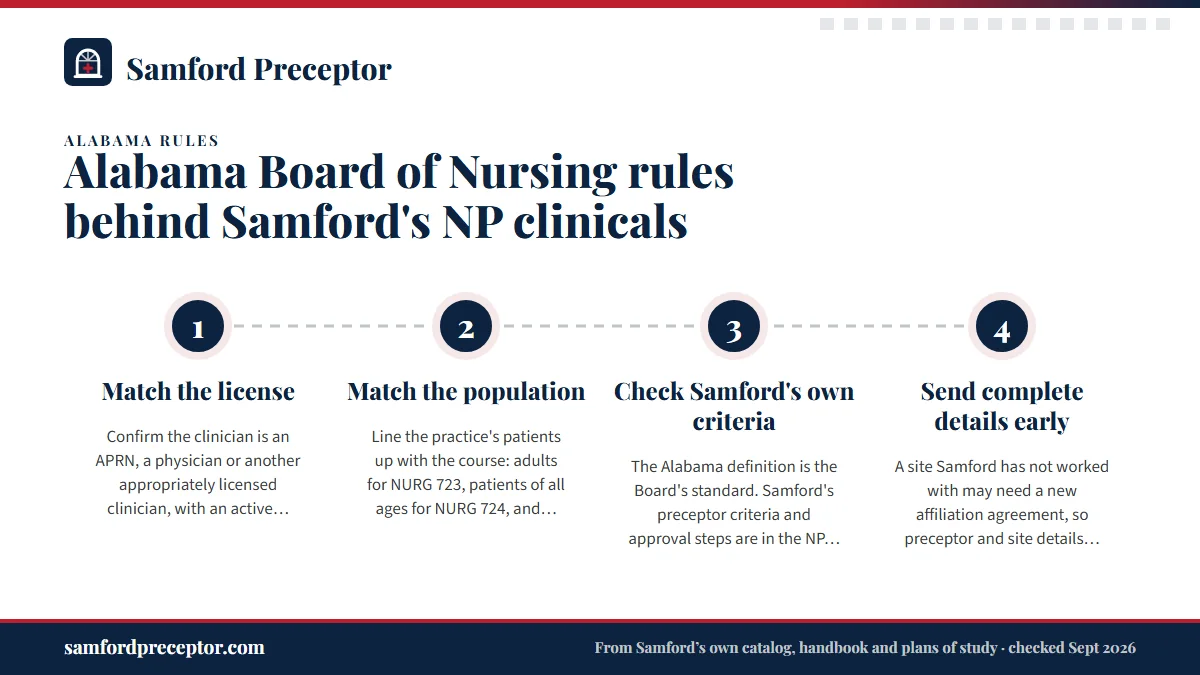
- Match the licenseConfirm the clinician is an APRN, a physician or another appropriately licensed clinician, with an active license in the state where you will rotate.
- Match the populationLine the practice's patients up with the course: adults for
NURG 723, patients of all ages forNURG 724, and psychiatric-mental health care fromNURG 788throughNURG 790. - Check Samford's own criteriaThe Alabama definition is the Board's standard. Samford's preceptor criteria and approval steps are in the NP Clinical Manual, and Samford approves every preceptor and site.
- Send complete details earlyA site Samford has not worked with may need a new affiliation agreement, so preceptor and site details should reach Samford well before the term begins.
This is where the placement desk does its most careful work. We find a clinician in your community whose license and patient population fit the exact Samford course, confirm the practice can host you for the hours in your plan of study, and put the details Samford asks for in your hands. Our preceptor requirements guide lists what to confirm, and you can send us your course and term to start.
The Alabama definition is the floor, not the finish line. A clinician can fit rule 610-X-3-.01(9) and still be the wrong match for your Samford course; the NP Clinical Manual and Samford's approval decide.
Questions Samford students ask
Can a physician precept a Samford nurse practitioner student in Alabama?
Yes. Alabama's advanced practice preceptor definition lists physicians in the same breath as APRNs. The physician's practice still has to fit the population your course covers, such as family care for the FNP courses or psychiatry for the PMHNP courses, and Samford reviews and approves each preceptor before hours count toward your plan.
Where can I read the Alabama Board of Nursing education rules?
The Board links its administrative code from its website, and the Alabama Administrative Code site posts chapter 610-X-3 as a PDF showing its revision date. Rule .01 holds the definitions, .02 the general program standards, .05 the extra requirements for advanced practice programs, .08 distance education, and .09 programs based outside Alabama.
Does Alabama law set the number of clinical hours for an NP student?
The advanced practice rule in chapter 610-X-3 points supervised experiences to national accreditation, certification and education standards. For the hours you must actually log, Samford's plans of study are the source: 750 clinical hours for most FNP and PMHNP options and 1,050 in the FNP BSN to DNP plan, spread across the NURG clinical courses.
What does population-focused mean for an FNP preceptor?
It means the clinician's practice serves the patient population your role is built for. In Samford's FNP sequence that is family care across the lifespan, with NURG 723 centered on adults and NURG 724 spanning all ages. A clinician who sees only one narrow group may suit one course and not the next, so check each course's focus before agreeing.
Do Samford nurse anesthesia students fall under the same preceptor rule?
Nurse anesthesia is an advanced practice program, so the .01(9) definition applies. Samford's nurse anesthesia handbook layers on its own limits: only CRNAs or anesthesiologists who hold staff privileges and can be reached at once may supervise, and a single preceptor covers two students at most. Samford assigns nurse anesthesia clinical sites itself.
Related pages
Last checked 2026-09-25
We check these pages against Samford's own program pages, plans of study, the 2026-27 Graduate Nursing Student Handbook and Alabama rules. Your course, your program coordinator and Graduate Student Services have the final word.
Samford says connections are essential. We are the connection.
Tell us your Samford track, where you live and when your next clinical course starts. We find preceptors near you who fit the course and prepare the details Samford needs to approve the rotation, including a new affiliation agreement where one is needed.
- Preceptors matched to the course: adult primary care for
NURG 723, family practice across the lifespan forNURG 724, psychiatric care forNURG 788 - Preceptor, license and site details ready for your clinical rotation request
- In your own community, anywhere Samford accepts you and your RN license is valid
Start your placement plan
Program, city and start date is all we need to begin.