Travel for Samford clinicals: planning the drive
Every current Samford NP program page says travel may be needed to meet clinical requirements or learning needs, and that the school does not arrange or provide reimbursement for travel. Getting to clinicals is yours to plan and pay for, which makes the distance to your preceptor one of the biggest choices in the program. A preceptor near home is the best travel plan there is.
Keep your clinicals close to home
Tell us your town and your next clinical course. We search outward from your home, not from Birmingham.
What Samford says about clinical travel
The travel line sits in the Clinicals & Practicum section of every current FNP and PMHNP page, right after the passage on affiliation agreements and connections (read that passage here). Samford notes that "traveling for clinical opportunities may be needed" and that the school "does not arrange or provide reimbursement for travel." The graduate catalog adds that students are responsible for transportation to and from clinical experiences.
The wording has shifted a little over time. Between 2022 and 2024, the PMHNP page said travel was sometimes needed and compared clinical placement to obtaining employment. The reimbursement sentence has stayed the same throughout.
In practice it means three things. You decide how far you are willing to go. You cover the cost. And a closer preceptor saves you time in every week of every clinical course, which adds up across a program with three or four of them.
How often you will make the trip
Samford's program pages put NP clinical time at 10 to 20 hours per week depending on the rotation, and each clinical course fills a semester. Dividing a course's hours by the weeks in its term gives a rough weekly load. The figures below are our arithmetic from Samford's plans of study and the 2026-27 College of Health Sciences graduate calendar, assuming the 12-week graduate summer term; they are not Samford numbers, and your syllabus and preceptor set the real schedule.
| Course | Hours | Term used | About per week |
|---|---|---|---|
NURG 723 (FNP, summer) | 150 | 12-week summer | 12 to 13 |
NURG 724 (FNP, fall) | 300 | 15-week fall | 20 |
NURG 730 (FNP, spring) | 300 | 15-week spring | 20 |
NURG 788 (PMHNP, summer) | 150 | 12-week summer | 12 to 13 |
NURG 789 (PMHNP, fall) | 225 | 15-week fall | 15 |
NURG 790 (PMHNP, spring) | 300 | 15-week spring | 20 |
At 20 hours a week, two 10-hour clinic days mean four one-way drives; three shorter days mean six. Multiply your one-way drive time by that count and by the weeks in the term, and the value of a nearby preceptor is plain.
Setting a distance limit before you search
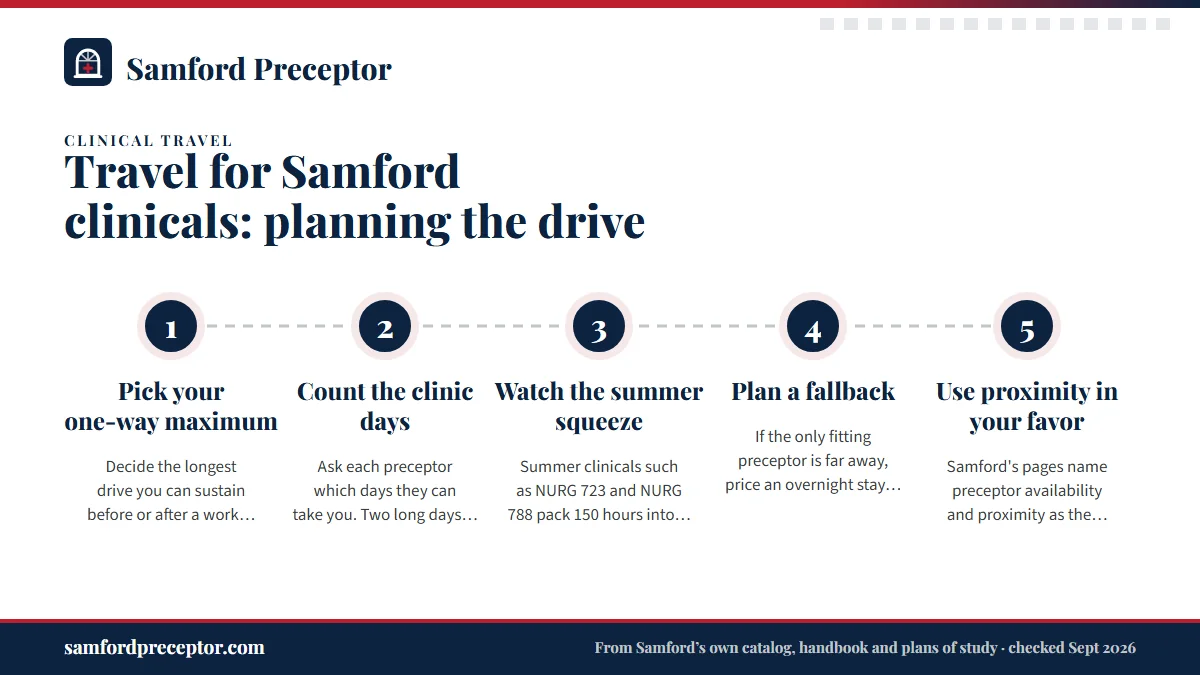
- Pick your one-way maximumDecide the longest drive you can sustain before or after a work shift, in ordinary traffic and in bad weather.
- Count the clinic daysAsk each preceptor which days they can take you. Two long days cost fewer trips than four short ones.
- Watch the summer squeezeSummer clinicals such as
NURG 723andNURG 788pack 150 hours into a shorter term, so a long drive hurts most there. - Plan a fallbackIf the only fitting preceptor is far away, price an overnight stay on clinic days before you say yes.
- Use proximity in your favorSamford's pages name preceptor availability and proximity as the bases for requesting a new affiliation agreement, so a preceptor near home fits the way Samford expects those requests to be made.
The common mistake is saying yes to the first willing preceptor without pricing the drive across a full semester of clinic days. Do the math first.
Costs to budget for
Samford's program pages leave clinical travel costs with the student, so put your own numbers against each of these before a rotation starts:
- Fuel, tolls and parking for every clinic day, plus wear on your car.
- Lodging and meals when a site is too far to drive there and back in one day.
- Lost shifts or unpaid leave from your RN job on clinic days.
- Site onboarding: the handbook allows extra background checks, drug tests and fingerprinting at student expense when a clinical facility requires them, and Huntsville Hospital's student page lists a student badge that students pay for. See background checks and drug testing.
- Trips to Birmingham for the on-campus intensives, which the intensives page covers.
Every new site can add its own onboarding, so the number of sites in your plan affects cost as much as the distance to each one.
When Samford sets the travel: nurse anesthesia and BSN
Nurse anesthesia students do not choose their sites. The Class of 2029 nurse anesthesia handbook says students will be assigned to several "out of town" clinical sites that may be a significant distance from campus, and the Director of Clinical Services gives out clinical schedules for semesters 6 through 9 during semester 5. The program keeps the weekly commitment under 64 hours, which matters when a long drive sits on top of a long case day.
BSN and second-degree BSN clinicals take place in Birmingham-area hospitals and selected community settings the school chooses, so travel there is a local commute. For both groups, our role is planning and compliance support rather than choosing sites. The Nurse Anesthesia DNP page covers the CRNA path.
Rural Alabama: distance and the preceptor tax credit
Students in rural Alabama can face long drives to the large health systems in Birmingham, Huntsville, Montgomery and Mobile. A preceptor closer to home may be more reachable than it looks. A rural family practice that sees both adults and children can suit either FNP clinical course, and it may sit much closer to your door.
Under Alabama's Preceptor Tax Incentive Program, some community-based preceptors working in medically underserved rural areas can claim a state income tax credit, counted per 160-hour rotation and limited to rotations that support eligible Alabama programs. Eligibility runs through the school's registration with the Alabama Statewide AHEC Program Office, and Samford's registration is not confirmed publicly, so ask your program before counting on it. The tax credit page explains who qualifies, and our Alabama regions guides describe each part of the state.
How we keep your drive short
Your placement advisor searches outward from your home, not from Birmingham. We look for preceptors whose practice fits the course and whose clinic days fit your work schedule, and we tell you the drive before you commit.
Distance is one of the first facts we report on every preceptor we propose, next to course fit and clinic days, so you can compare options on the numbers that matter to you. Should a preceptor pull out partway through a term, your advisor hunts for the next one inside the same radius.
When the nearest fit is still far away, we look for a practice that can host you for more than one course, so the onboarding and the route are learned once. Start with the form below.
Questions Samford students ask
How far is too far to drive for NP clinicals?
Samford sets no published distance limit. The practical limit is what you can keep up for a full semester at 10 to 20 hours a week, usually two or three trips weekly, on top of work. Set a one-way maximum before you search and hold to it unless no closer preceptor fits the course.
Do I have to drive to Birmingham for my NP clinical hours?
No. NP clinical hours happen in your own community, wherever Samford accepts you. Birmingham trips are for the on-campus intensives. Nurse anesthesia students are the exception, because their sites are assigned and may be far from campus, and BSN students rotate in Birmingham-area settings the school selects.
Can I stay with family in another town for clinicals?
Yes, if the site works for Samford. A rotation in another town still needs an affiliation agreement, an approved rotation request and a valid RN license there; if it crosses a state line, read our page on clinicals outside Alabama. Staying near the site on clinic days can turn a punishing commute into a workable one.
Will a long commute affect my rotation request?
Samford's pages do not name distance as a reason to deny a request; state rules are the reason they give. Distance matters in a quieter way. Proximity is one basis for a new affiliation agreement, and a long drive raises the odds of missed clinic days when work or weather gets in the way.
Can one preceptor cover more than one of my courses?
Where the course fit allows and Samford approves each rotation, it can save a great deal of travel planning. A practice with pediatric and adult patients could host NURG 724 and later NURG 730, for example. Samford looks at every rotation request separately, so read each syllabus before you plan on it.
Related pages
Last checked 2026-09-25
We check these pages against Samford's own program pages, plans of study, the 2026-27 Graduate Nursing Student Handbook and Alabama rules. Your course, your program coordinator and Graduate Student Services have the final word.
Samford says connections are essential. We are the connection.
Tell us your Samford track, where you live and when your next clinical course starts. We find preceptors near you who fit the course and prepare the details Samford needs to approve the rotation, including a new affiliation agreement where one is needed.
- Preceptors matched to the course: adult primary care for
NURG 723, family practice across the lifespan forNURG 724, psychiatric care forNURG 788 - Preceptor, license and site details ready for your clinical rotation request
- In your own community, anywhere Samford accepts you and your RN license is valid
Start your placement plan
Program, city and start date is all we need to begin.